
PSAC FB Team Pushing for ‘25 and Out’ Pension Commitment

CBSA is a Law Enforcement agency. Officers working at CBSA should be afforded the same pension benefit as other enforcement workers.

In negotiations this week with Treasury Board/CBSA our FB Bargaining Team reiterated that we are seeking a commitment from CBSA and Treasury Board that will support an early retirement plan similar to what is in place for other federal law enforcement personnel. In light of the work that we do, and in light of the employer’s legal obligation to place officers that require accommodation, we believe that such a retirement arrangement is not only in the interest of employees in the FB bargaining unit, but is also in fact in the interest of the Agency.

Day Workers
There are a number of locations across the country where CBSA management has been revoking or canceling compressed work weeks and flexible working arrangements – from Inland Enforcement to Trade Compliance to Hearings Officers. Our Team discussed again the need for our new contract to provide new protections in this area.

VACIS and HCVM
This week our Team reminded management that the employer cannot make unilateral changes without first gaining the union’s consent. Consequently we notified the employer that should the Agency attempt to contract out work associated with VACIS and HCVM, we will contact our legal counsel.

Student Work
We made proposals that would require the union to be involved in the assigning of student work, and would protect union jobs from being held by students.

Sick Leave
We addressed the ongoing sick leave issue this week by stating that we continue to seek either a renewal or improvements to the current sick leave regime. We made it clear that any improvements would need to be contained in the collective agreement. We reiterated that the underlying purpose of a sick leave system is to ensure that workers are not forced to choose between going to work sick or collecting a pay cheque.

WFA
We reiterated to the employer that we are seeking significant changes to the Workforce Adjustment Appendix. Our demands seek to preserve and improve public services, enhance protections against involuntary departures and ensure that our seniority be recognized.

We are next scheduled to meet in bargaining the week of April 11th. We’ll be sure to update as things progress.
PA bargaining: minimal interest from the employer

Our PA bargaining team met Treasury Board at the bargaining table this week with renewed determination. Unfortunately, the employer continued to display minimal interest in responding to our proposals.

Treasury Board did signal it is considering some very small movements in response to union demands in certain leave provisions, as well as improved notice provisions in the discipline article. But mostly, the Employer remained focused on sick leave concessions and complained that we had too many demands at the bargaining table.

Our bargaining team reiterated the objective to come to the table every three years or so to improve wages and working conditions and resolve problems. We tabled new language on student employment and reviewed with the employer our proposals on maternity and parental leave.

Treasury Board withdrew its demand to remove the PM-7 wage grid from the collective agreement. Our team understands there are currently no PA members at the PM-7 level, but we cannot be sure that this classification will not be populated in the future.

Work Force Adjustment: We reiterated the need for significant changes to the Workforce Adjustment Appendix in this round of bargaining. Our demands seek to make the rules more transparent and reduce the significant anxiety the process causes workers. We are also looking to preserve and improve public services, enhance protections against involuntary departures and ensure that seniority is recognized.

Sick Leave: We addressed the ongoing sick leave issue this week by stating that we continue to seek either a renewal or improvements to the current sick leave regime. We made it clear that any improvements would need to be contained in the collective agreement. We reiterated that the underlying purpose of a sick leave system is to ensure that workers are not forced to choose between going to work sick or collecting a pay cheque.

We will be back at the table the week of April 11, 2016. Stay informed by visiting psacunion.ca/pa

Update Regarding Workplace Accommodation

On February 17, 2016, members of the CIU National Executive, Sister Lisa Addario (PSACLegal Officer), Brother Murray Star (EO Representative), Brother Bruno Loranger (Labour Relations Officer) and the employer met to discuss accommodations and issues related to Appendix G-1.

In CIU’s update of January 7, we provided the following list of duties as being suitable for accommodated members at level:

  • Electronic Data Interchange (EDI)
  • Alternate Inspection Services (AIS) Risking
  • NEXUS Enrolment Centres
  • Inland Enforcement Officer (no road duty)
  • Commercial (back office)
  • Telephone Reporting Centres
  • Hearing Advisors
  • Postal Operations
  • National Targeting Centre

We also indicated that CBSA was looking at the suitability of other positions for accommodated members, namely those of Instructor duties at training centres and desk duties for Intelligence Officers and Investigators.

CBSA has indicated that it will consider accommodating members in these positions. It should be pointed out that several members are already being accommodated at Rigaud. The employer has also stated that it may want to place some of our members there whose positions will be (or have been) eliminated with the closure of firearm training facilities in Prince Edward Island and at Slack Road.

Regardless of the list of duties deemed suitable, it bears repeating that members who are already in accommodated positions that do not involve face to face enforcement interactions with clients will remain in those positions.

While CBSA is willing to consider accommodating desk duties for Intelligence Officers and Investigators (in addition to Rigaud and the other duties listed above), it has indicated that all must be considered on a case by case basis. For some duties, several positions may be available while for others (e.g. Inland Enforcement Officer – no road duty), the number may be limited. CBSA further clarified that it needs to take into account the viability of suggested accommodations and must also meet financial, regional and operational requirements. Obviously, members who are placed in these positions must also have the necessary skills and knowledge (e.g. language, specialized training) to do the job.

The employer believes it has made great progress in accommodating those 108 officers who had been performing face to face enforcement but could not pass the DFC training. However, it also acknowledges that there will be other officers similarly situated who, in the future, will require accommodation.

It is the employer’s position that if a member is registered for DFC and is “trainable”, that member can remain in his/her position beyond March 31, 2016. The employer defined “trainable” as a member who either: a) has been scheduled to go to DFC; b) has failed DFC but is being provided with remedial support from the employer; or c) is in the process of obtaining their CAT III.

The employer agreed to remove the requirement for a CAT III medical for members working in postal operations.

CIU also raised concerns about CBSA requiring members to go to a Health Canada doctor for their CAT III. CIU reminded the employer that there is no legal requirement for our members to see the company Doctor.

If a member has failed the MMPI twice, CIU encourages that member to speak with a CIU Labour Relations Officer to determine next steps.

Members who do not want to attend DFC training but who plan to retire in the short term should discuss this with their Branch President. Together, they can approach the employer to discuss possible retirement dates/interim solutions. Again, note that this will be considered on a case by case basis. Note also that the shorter the period requested, the more likely it is to be approved.

The employer repeated that it had no intention of demoting accommodated officers or lowering their pay and added that such rumours were “science fiction”. They also agreed to speak with regional management team members and CIU Branch Presidents in regions where such rumours had been reported. Both parties acknowledged that where management included the union in discussions with affected members, the process had gone smoothly. CIU reminded the employer that it was to its benefit to have the union involved. The employer agreed to make it clear to its affected employees that the union was available and on hand to participate in such meetings.

CIU again confirmed with the employer the principles upon which it agreed to participate in these discussions: that members who were already in accommodated positions would continue in those positions; members would be accommodated at level, with no loss of salary or benefits; and members would be offered meaningful work.

PA bargaining: new government, few changes at the table

The PA bargaining team came back to Ottawa with high hopes for a more productive bargaining relationship with the new Liberal government. Sadly, the Liberals’ new mandate for negotiations does not seem to be fully developed.
In three days of bargaining with the employer, our bargaining team discussed the definition of contact centres with the employer, as well as PSAC’s proposals for better working conditions in these centres.
We also stressed the importance of creating a joint union-management committee to review, recommend and implement minimum standards for working conditions in these contact centres.
Our union’s proposals for Article 25 – hours of work, and particularly the demand for shift scheduling by seniority, was another focus of discussion.

We will not trade away sick leave’
Treasury Board negotiators tabled a proposal similar to that of the previous Conservative government, that would replace our existing sick leave plan. It takes away existing rights and leaves members worse off. The proposed short term disability plan would fall outside of the collective agreement and allow the government to make unilateral changes any time.
We remain open to improvements on sick leave but we will not negotiate concessions or agree to any proposal that forces members to choose between losing pay or going to work sick.

Fair bargaining and Bill C4
We are pleased to see the government move to repeal Bill C-59 (division 20), but there is still another unfair labour law on the books. The unconstitutional changes to labour laws governing the collective bargaining process under C-4 remain a key issue.
It is a mystery why the government is not repealing this legislation in light of the clear pronouncements made by the Supreme Court in the Saskatchewan Federation of Labour case. We will continue to move forward with our litigation and take all necessary steps to ensure that there is free and fair collective bargaining for the federal public service.
At the bargaining table, PSAC will continue to focus on measures to improve the delivery and quality of public services and make the federal public service an efficient and healthy place to work. This benefits all Canadians.

Bargaining schedule
The bargaining schedule has increased in frequency from every two months to approximately every five weeks. We will be back at the table the week of March 7 and again the week of April 11.
Visit psacunion.ca/pa for updates.

Our Right to Free Collective Bargaining Must Be Respected

We uphold the Charter. We deserve nothing less.

This week was our FB Bargaining Team’s first week in negotiations with Treasury Board and CBSA under the new government. At the outset we re-iterated PSAC’s position that the new government must repeal Bill C-4 imposed by the Harper government. C-4 removed our right to strike and imposed unfair arbitration rules. It is unconstitutional legislation and we will ensure that our rights are respected.

Technological change, Firearm practice and “tool-up time” discussed

In bargaining this week we made proposals to protect against the elimination of officer positions due to the introduction of technological change. We explained that ABC machines and the chronic increase in remote reporting is putting public safety at risk, and made proposals accordingly. We also made proposals that would ensure that officers have access to firearm practice on work time, and would ensure that time spent tooling-up and tooling-down is considered work time.

Compressed Work Week, Day Worker Issues

Many workers in the FB bargaining unit are not subject to VSSA’s. These include Trade Compliance, Intelligence, Investigations, Inland Enforcement Officers and others. There have been issues recently with management revoking flexible working arrangements and compressed work weeks. We tabled proposals to better protect these scheduling arrangements against management making unilateral changes.

We will not trade away sick leave

Treasury Board negotiators tabled a proposal similar to that of the previous Conservative government, that would replace our existing sick leave plan. It takes away existing rights and leaves members worse off. The proposed short term disability plan would fall outside of the collective agreement and allow the government to make unilateral changes any time. We remain open to improvements on sick leave but we will not negotiate concessions or agree to any proposal that forces members to choose between losing pay or going to work sick. We are meeting again next month. For more information visit psacunion.ca/fb

Update Regarding Workplace Accommodation

In September 2015, CIU provided an update to its members with respect to the arming initiative and the CBSA position that, as of April 2016, no officer will perform face to face enforcement duties without the appropriate defensive equipment.

Since then – and most recently on December 8 – the CIU National Executive members, Jean Pierre Fortin, Mark Weber, André Beaulieu, Brea Lewis and Chantal Rajotte along with the Equal opportunities Representative, Murray Star, PSAC Legal Officer, Lisa Addario and Labour Relations Officer, Laurel Randle met a number of times with the employer to discuss placement strategies for our members who cannot be armed due to an accommodation.

Regional meetings involving CIU Branch Presidents and National Vice-Presidents along with either Sister Randle or Addario or Brother Fortin, CBSA Directors and Regional Directors General were held in Halifax, Montreal, Ottawa, Toronto, Winnipeg and Vancouver in preparation of the employer’s meeting with members to discuss specific placement offers/options.

The National and Regional meetings were held to respond to management’s plans for the placement of members who are/were performing face to face enforcement duties without the defensive equipment that the employer has determined is required to perform those duties. The employer had identified 108 employees from across the country who fit into this group.

Although placement discussions were to have been held with each of these members prior to the December 8 meeting, our understanding is that some discussions have been delayed due to shifting priorities at the CBSA (dealing with the Syrian Refugees).

Our members who have limitations or restrictions based on a human rights ground are entitled to a reasonable accommodation. Although many wish to remain in their current face to face roles, the employer’s position is that it cannot allow this beyond March 31, 2016.

The Canadian Human Rights Commission provides that the employer has a duty to accommodate. Jurisprudence has established that while an accommodation must be suitable, it does not have to be perfect.

The employer has identified the following duties as being suitable for accommodated members at level:

  • Electronic Data Interchange (EDI)
  • Alternate Inspection Services (AIS) Risking
  • NEXUS Enrolment Centres
  • Inland Enforcement Officer (no road duty)
  • Commercial (back office)
  • Telephone Reporting Centres
  • Hearing Advisors
  • Postal Operations
  • National Targeting Centre

CIU has enquired about Instructor duties at the training centres and desk duties for Intelligence Officers and Investigators. The CBSA is looking at these profiles.

Your union does not agree with the employer’s broad position that it cannot accommodate members in certain face to face enforcement duties. However, in cases where CBSA offers a member who requires accommodation a position that is at the same group and level, within the same worksite and consistent with the member’s functional limitations, the employer may have met its legal duty to accommodate. Every case requiring accommodation must be individually considered. Members should immediately contact their Branch President if they believe the position(s) offered to them are unsuitable/unreasonable.

CBSA informed us that approximately 600 employees are currently being accommodated and are not involved in face to face enforcement. These accommodations are not being changed.

The employer has agreed to consider requests from members who do not want to attend firearm training and who will retire in the short term (less than a year). The CBSA has made it clear, however, that these members will not remain in face to face enforcement positions beyond March 2016. Note that CBSA has informed us that such requests will be dealt with on a case by case basis.

Situations where members have taken a demotion because of the firearms implementation are being reviewed by the CBSA. It will get back to CIU with numbers and details.

The CBSA has also agreed to review situations where members have reconsidered their request to retire if that initial retirement request was made because of the impending firearm implementation.

We encourage our members to talk to their Branch President and, because the National Vice Presidents and Equal Opportunity Representative also sit on the National Strategy committee, issues can be raised with them as well.

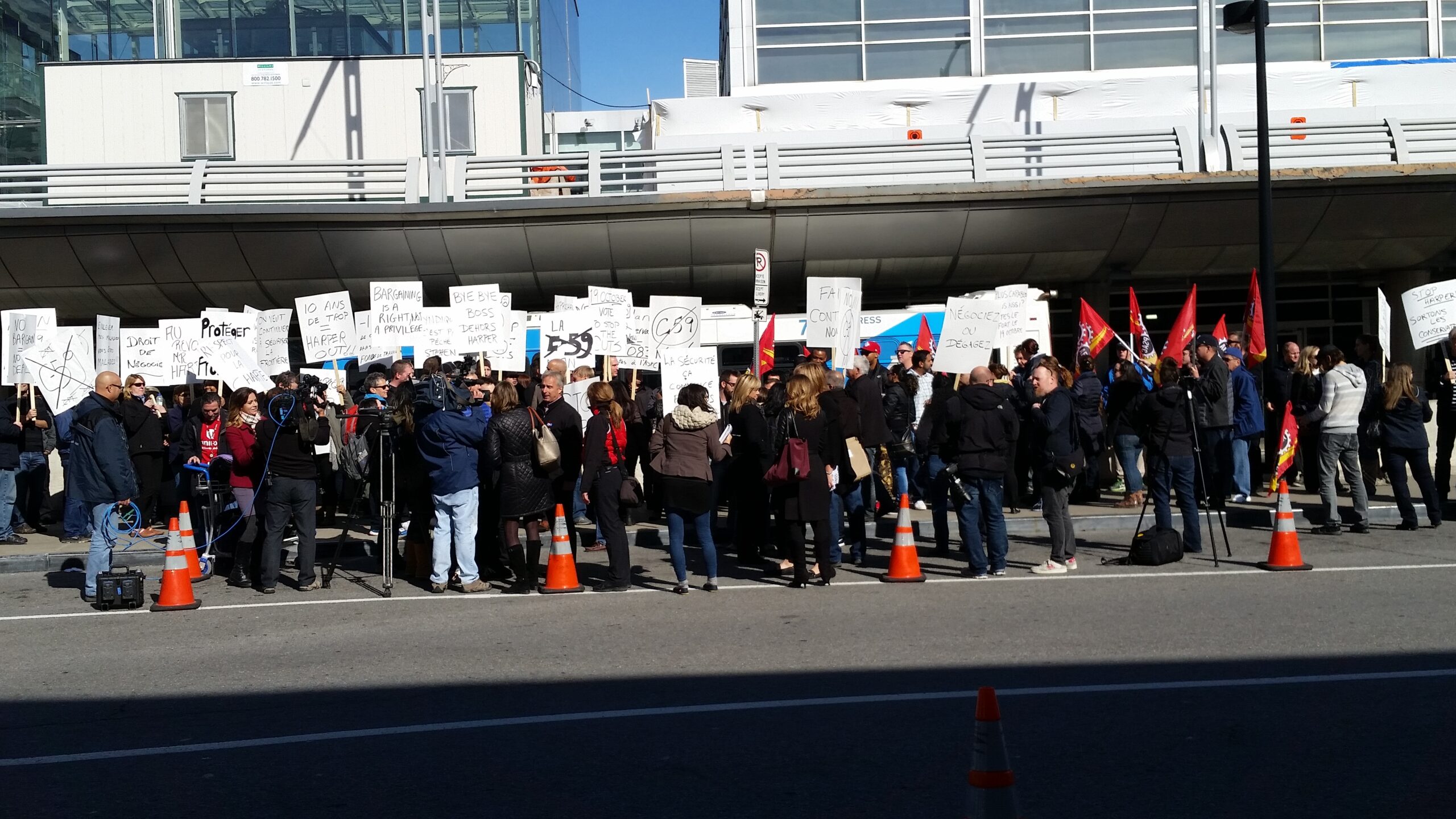
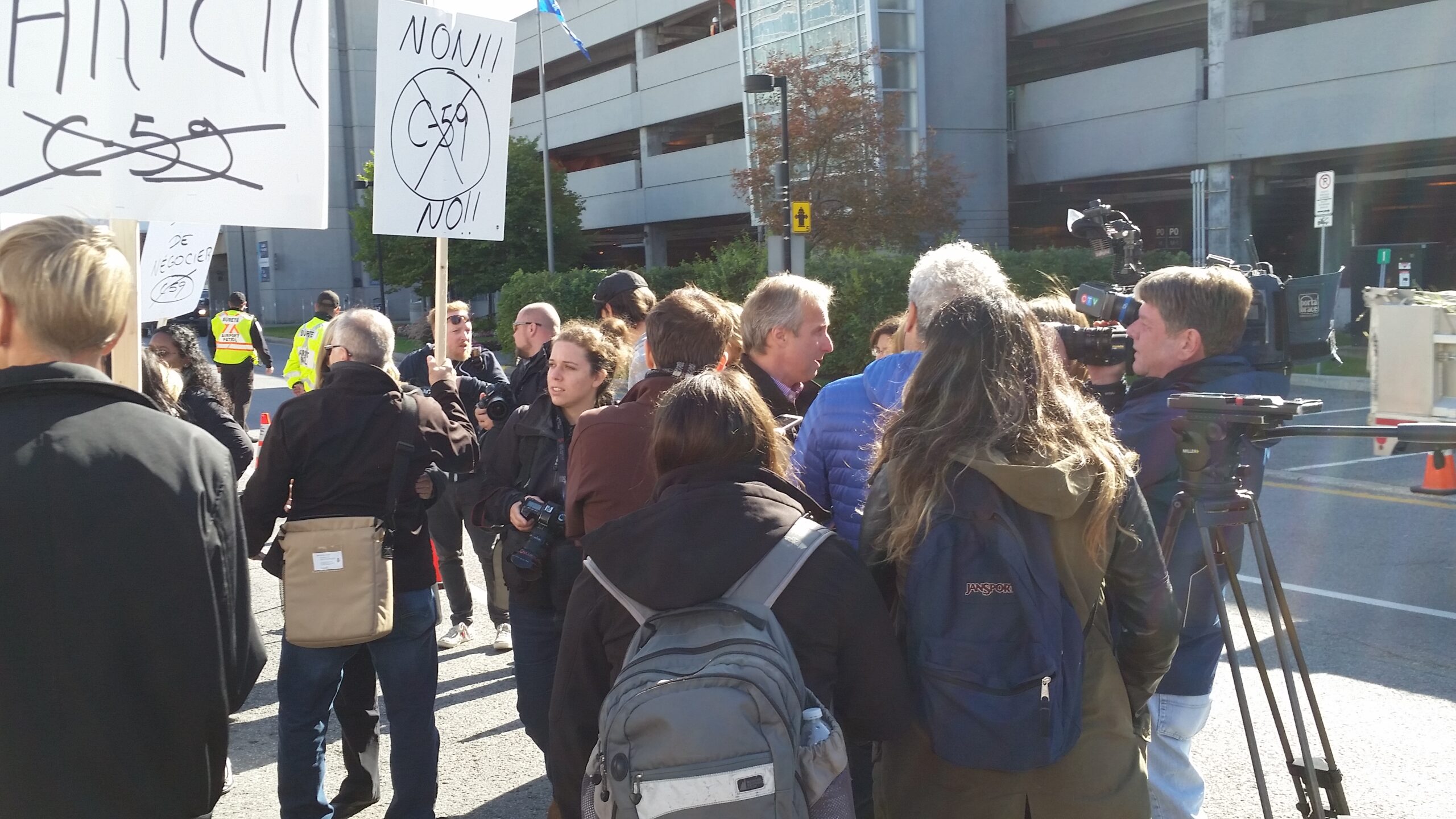
CIU Members Demonstrating in Montreal for Border Security

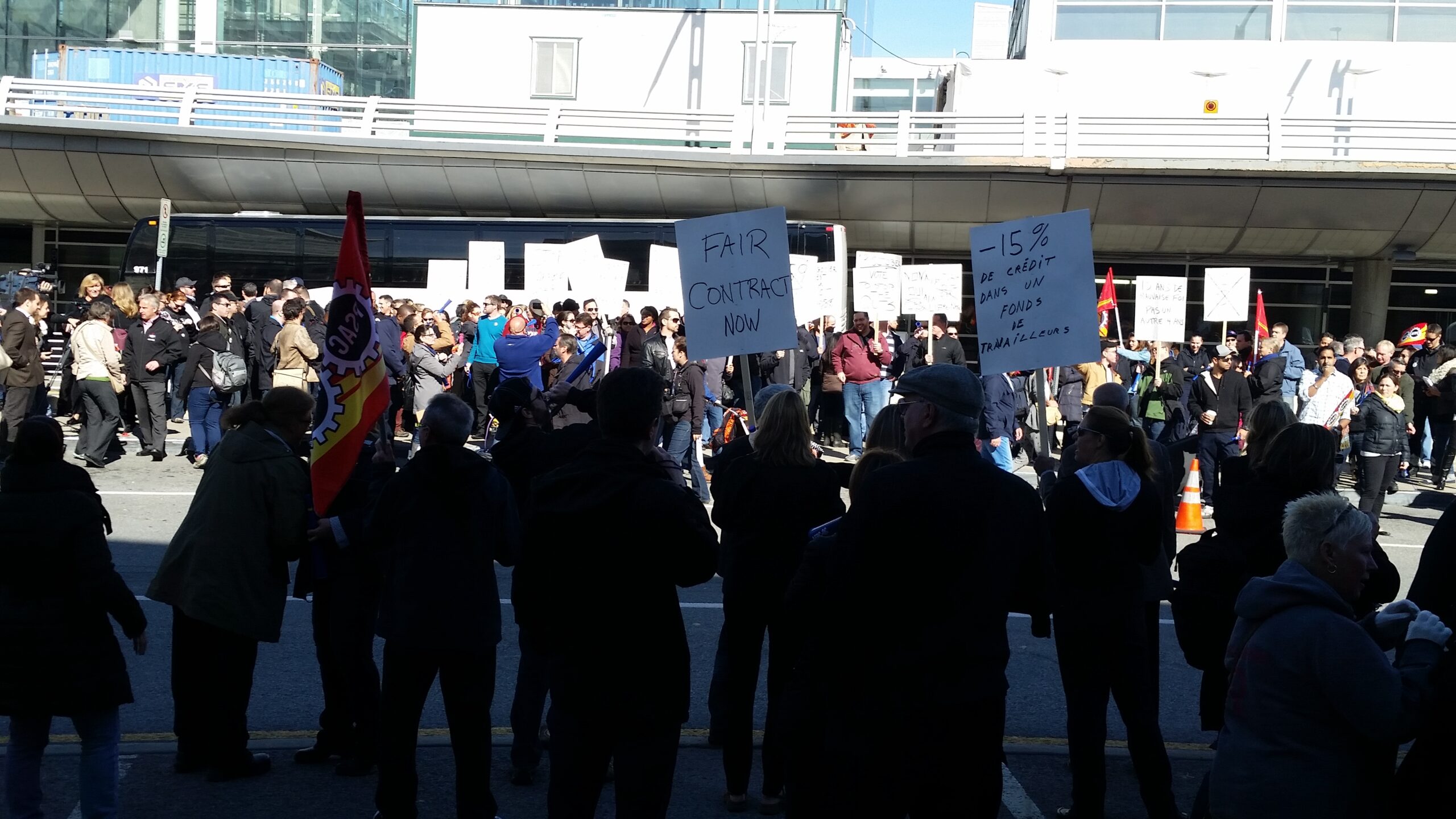
On October 8, more than 250 members demonstrated at the Montreal-Trudeau Airport to demand greater border security in Canada. More than 1,000 positions, including front-line border workers, sniffer-dog teams and intelligence officials have been cut by the Conservative government.

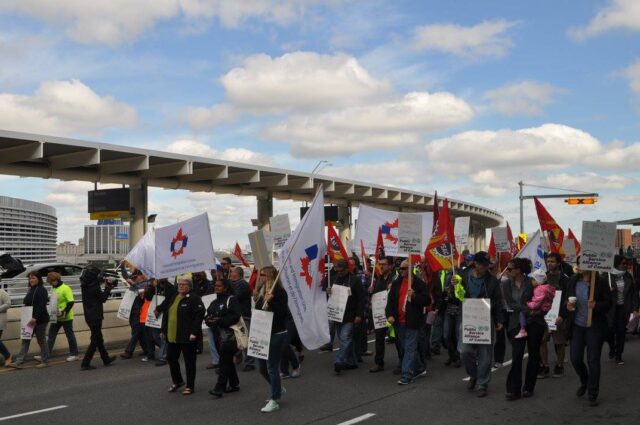
CIU Members demonstrating in Toronto for border security

In 2013, CBSA installed Automated Border Clearance (ABC) kiosks at three airports: Montreal, Toronto and Vancouver. These kiosks are having a detrimental effect on the security of Canadians. You can’t replace people with machines. Since the introduction of this technology, seizures have dropped by 25%. On October 8, more than 100 CIU members demonstrated at the Pearson Airport to demand greater border security in Canada.

CIU Members demonstrating in Vancouver for border security

On Thursday October 8, one hundred CIU members in Vancouver voiced their concerns regarding the Harper government systematically attacking our rights and collective agreements. First it was severance, then it was our right to strike. The Conservatives are putting national security at risk by cutting CBSA staff and replacing officers with machines.

Strategy regarding workplace accomodation

It has been some time since we have provided an update to our members with respect to those of you who cannot take the CDT and Arming course based on a ground listed in the Canadian Human Rights Act (CHRA) or who have tried and been unable to successfully complete the course.

Much has transpired since last April when the CBSA issued its Letters of Confirmation. The CBSA remains fixed on having only tooled/armed members with face to face enforcement duties working on the front line. While the CIU/PSAC disputes that the employer has established this as a bona fide occupational requirement, we are nonetheless working with the CBSA to ensure that our members are treated fairly.

With that in mind, the CBSA and CIU/PSAC (CIU National Executive: Mark Weber, Brea Lewis, André Beaulieu, Chantal Rajotte and myself as well as CIU National EO Representative Murray Star, PSAC Legal Officer Lisa Addario and CIU Labour Relations Officer Laurel Randle) have been working to establish a strategy for the placement of the CBSA employees/CIU members who require accommodation or placement for reasons outlined in the first paragraph above.

We first worked to agree on some principles. In the meantime, the employer undertook to have regional management and human resources compile preliminary lists of employees who hold front line positions and who need to be accommodated under the CHRA, and to look at placement opportunities for these employees within those regions.

The CBSA has asserted that our members who are already in accommodated positions that do not involve face to face enforcement interactions with clients will remain in those positions.

For those employees who are in face to face enforcement positions, have limitations that are at least twelve months in duration and who will require accommodation by the March 31, 2016 arming implementation deadline, accommodated positions will be offered to them at their substantive level. This accommodation will be negotiated on a case by case basis. The employer has asserted that it has sufficient meaningful work for all these employees.

Under federal law, the employer has a duty to accommodate employees to the point of undue hardship and CBSA recognizes this obligation.

The CIU will be monitoring this process closely. We must also make sure that the list of employees compiled by the employer is comprehensive.

We have asserted that the employer ought not to be offering our members demotions in this process and the principle agreed to by the CBSA is to find positions that are at the members’ substantive group and level.

With the above principles established, the parties agreed to a pilot for Southern Ontario Region within the Border Services Officer community. During the third week in August, CBSA management met with CIU representatives in Niagara Falls. Preliminary discussions were held wherein the CBSA brought forward the names of our members impacted as well as potential placement opportunities. Initially, the next step was for CIU representatives to meet with members individually to discuss their particular needs and options. However – and because we recognized that once such discussions would start, news would certainly spread and questions would abound – it was decided that before taking that step we would provide our membership with this piece of communication to inform them of the strategy and the meetings that will take place over the coming months.

The SOR Branch Presidents, National Vice-President for that region and CIU/PSAC staff members as required will meet in the near future with the impacted members individually. Subsequently, the employer, employee and Union representatives will meet so that accommodation arrangements can be determined.

Once the pilot in SOR is reviewed, such meetings will take place across the country, with the next region being the Atlantic. A schedule will be made available for the remainder of the country (before the end of September).

As a party to the accommodation process, the Union’s obligation is to not block a reasonable accommodation plan. The employer intends to canvass employees who currently meet the use of force requirements and are not in front line positions, inviting them to consider other positions in this regard so as to ensure continued employment opportunities for those members who require an accommodation in an unarmed/untooled position.

CIU and PSAC will be making every effort to ensure that the transition is as smooth as possible. If you have any questions regarding the above, please see your union representative or Branch President.