
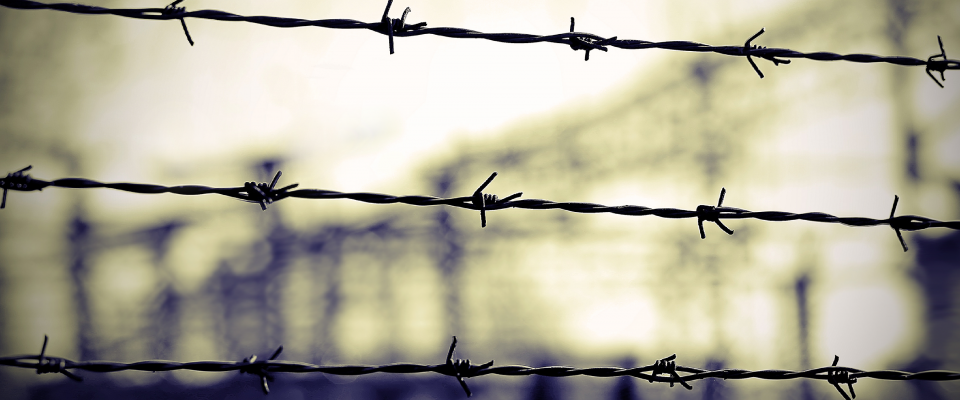
Significance of barbed wire: During the Holocaust, barbed wire fences surrounded concentration and extermination camps, including Auschwitz-Birkenau. Over time, barbed wire has become a widely recognized symbol of how ordinary infrastructure and policies were used to carry out cruelty.
January 27 is International Holocaust Remembrance Day, marking 81 years since the liberation of Auschwitz-Birkenau, the largest Nazi concentration and extermination camp. It is a day to remember the millions of people murdered during the Holocaust and to honour the survivors whose lives and voices carry this history forward.
Also known as the Shoah, the Holocaust was the systematic persecution and murder of Jewish people organized by Nazi Germany and its allies between 1933 and 1945. Approximately six million Jewish people were killed. Alongside, millions of non-Jewish victims were murdered because of who they were or what they believed.
Those persecuted and murdered also included unionists, labour organizers, social justice activists, political opponents, Romani and Sinti peoples, people with disabilities, 2SLGBTQ2IA+ people, Slavic peoples, Black and racialized people, Jehovah Witnesses, and other religious groups such as Catholics who resisted or were deemed a threat by the Nazi regime. This genocide was carried out through laws, propaganda, forced labour, mass shootings, and a vast network of camps.
Camps, cruelty, and genocide
Between 1933 and 1945, Nazi Germany established more than 44,000 concentration camps, labour camps, and sub-camps across occupied Europe. Conditions were brutal — marked by starvation, disease, overcrowding, forced labour, torture, and mass murder.
Certain individual camps and certain areas within concentration camps were designated specifically for female prisoners. In May 1939, the Schutzstaffel (SS) opened Ravensbrück, the largest Nazi concentration camp established for women. Over 100,000 women had been incarcerated in Ravensbrück by the time Soviet troops liberated the camp in 1945.
Auschwitz-Birkenau alone was the site of over 1.1 million deaths, most of them Jewish people. Other extermination camps included Treblinka, Sobibor, Belzec, Chelmno, and Majdanek.
Canada was not immune to antisemitism during this period. Immigration policies were designed to prevent Jewish refugees from entering the country. In 1939, Canada turned away 907 Jewish refugees aboard the MS St. Louis, forcing the ship back to Europe. Nearly 254 passengers later died in the Holocaust.
This year, the United Nations’ theme for International Holocaust Remembrance Day emphasizes the importance of education, remembrance, and safeguarding historical truth to help prevent genocide and mass atrocities in the future. Remembering the Holocaust is not only about the past — it is about learning from history and applying those lessons today.
PSAC’s commitment to equity and justice
PSAC strongly condemns all forms of discrimination and hate, including antisemitism. Every worker deserves dignity, safety, and respect — in the workplace, in our union, and in our communities.
As hate crimes and discrimination continue to rise, International Holocaust Remembrance Day reminds us that remembrance must lead to action. We all have a responsibility to speak out, challenge injustice, and stand in solidarity with those who are targeted today.
Honouring the victims of the Holocaust means continuing to learn from history and applying those lessons today. PSAC remains committed to building inclusive workplaces and communities rooted in equity, inclusion, and respect for all.
Available resources
-
- 2026 Holocaust Remembrance and Education – UN Outreach Programme on the Holocaust
- International Court of Justice – Nuremberg Trials – World War II accountability and the foundations of international justice
- National Film Board of Canada – Bilingual documentary offering historical context and survivor perspectives
This article was first published on the PSAC website.