

Bear Witness Day: Take action to support First Nations children, youth and families

On May 10, we recognize Bear Witness Day to raise awareness for Jordan’s Principle — a child-first principle and legal rule named in memory of Jordan River Anderson that ensures First Nations children receive the same standard of social, health and educational services as the rest of the Canadian population.

This year, we were encouraged to see the 2022 federal budget include a section dedicated to Jordan’s Principle and propose $4 billion over six years to ensure First Nations children continue to receive the support they need. This is a significant improvement over the 2021 budget, where there was only a passing mention of Jordan’s Principle and vague commitments to First Nations children.

But promises are easily made and just as easily broken.

We will continue to keep a close eye on this important issue and expect the government to follow through on their commitment. We are all responsible for protecting and defending the rights of Indigenous peoples, especially children.

Show your support and “Bear Witness”

PSAC is proud to be one of the first unions in Canada to recognize this day annually. We encourage all PSAC members to take part in actions in support of reconciliation and equity.

One way to do that is to support the ongoing work of the First Nations Child & Family
Caring Society by sending a letter to your MP calling on them to endorse the Spirit Bear Plan to end the injustices experienced by First Nations children and families living on reserve and in the territories.

PSAC also encourages everyone to learn more about Jordan’s Principle by watching the documentary Jordan River Anderson, The Messenger by acclaimed Indigenous director Alanis Obomsawin. The film tells the story of how the life of Jordan River Anderson initiated a battle for the right of First Nations and Inuit children to receive the services they need, when they need them.

Visit the First Nations Child & Family Caring Society’s website for other ideas on how to support and honour Bear Witness Day through education, awareness, and action.

This article was first posted on the PSAC website.

PA bargaining: Treasury Board ignores key wage, equity issues

Negotiations at the PA table are nearing the breaking point after Treasury Board presented their comprehensive offer on April 28 rife with concessions and which fails to respond to most of the PA team’s key demands.

The employer refused to budge on the unacceptable wage offer they presented at the Common Issues table in March, with economic increases averaging 1.75% per year that fall well below inflation. Treasury Board also completely ignored the PA team’s key demand for wage parity with members at the Canada Revenue Agency.

Mental health and equity overlooked

The bargaining team was dismayed by Treasury Board’s silence on proposals related to mental health and equity. The employer did not respond to the team’s proposal for leave to support employee mental health and was completely silent about our proposal for an allowance to recognize employees who use Indigenous languages in the workplace.

Treasury Board continues to reject PSAC’s proposals for mandatory training to address systemic racism, harassment, and discrimination for all federal public service workers and managers at the Common Issues table. This has left the team with no evidence that the government recognizes the need to dismantle systemic racism and address discrimination in the federal public service.

Our bargaining team is very concerned about the lack of progress towards a fair deal for PA members.

Upcoming national event, stay updated

Other Treasury Board groups including SV, TC, and EB have bargaining dates set for May, which will give a clearer picture of how Treasury Board negotiations will shape up going forward.

As Treasury Board bargaining reaches a critical point, we encourage you to register for our May 17 national panel to discuss the latest bargaining news, why strong mobilization is more important than ever, and how other PSAC members have taken job action to win important victories during the pandemic.

You can also stay informed and engaged during this round of negotiations using our bargaining toolkit.

Please be sure to keep your contact information up to date via the member portal to receive all the latest updates as we negotiate your next contract.

This article was first posted on the PSAC website.

Asian Heritage Month: Remembering the past, shaping the future

It’s been 20 years since the federal government officially recognized Asian Heritage Month, but Asian and Asian-Canadian workers have been contributing their labour – and organizing for workers’ rights – for at least 200 years before that.

From building Canada’s railways to working in lumber, mining and agriculture, and later in health and other care professions, Asians from a wide variety of ethnic origins have built and enriched this country and its labour movement from the ground up since the 18th century. 

Anti-Asian racism in the workplace and in our unions dates back to those early days as well. In the late 1800s, Chinese workers in Canada were prohibited from joining unions. In the early 1900s, Canadian immigration laws were changed to deter and prevent East and South Asian workers from entering the country.

Fighting for workers’ rights 

People of Asian heritage in Canada continue to work and organize for workers’ rights despite these challenges. In the first half of the 20th century, East and South Asian workers formed their own unions demanding higher wages and better working conditions. Into the 21st century, they successfully mobilized to change immigration laws, providing better working conditions for migrant caregivers.

Since 2000, a grassroots collective of Asian community and labour activists have worked through the Asian-Canadian Labour Alliance (ACLA) to build an Asian-Canadian labour identity and represent Asian-Canadian trade union members and workers in the broader labour movement.

Anti-Asian racism continues 

Asian-Canadian workers, union leaders and organizers continue to contribute to Canada’s workplaces today. However, anti-Asian racism persists, as seen by a lack of representation in leadership positions, racial micro-aggressions, dehumanizing and divisive stereotypes, and the rise of anti-Asian hate throughout the pandemic.  Between 2019 and 2020, the number of police-reported hates crimes against the East or Southeast Asian population increased by 301 per cent, and incidents of violence against the South Asian population increased by 47 per cent.

Our union is taking action 

PSAC is demanding change by calling on the federal government to provide equity, diversity and inclusion training for all federal public service workers, and advocating for changes to the federal Employment Equity Act to address exclusion and discrimination in the federal public service.

We are also finalizing PSAC’s Anti-Racism Action Plan that will review how our union serves, mobilizes, engages and represents our Black, Indigenous, Asian and racialized members. Members will be able to learn and be heard through education sessions and workshops, a dedicated membership survey, focus groups, telephone townhalls, discussions and more.

We will be sharing a timeline of key moments in Asian-Canadian labour history later this month, and urge you to join us in taking action to combat anti-Asian racism – and all forms of racism – in our workplaces and communities.

Get engaged and take action 

This article was first posted on the PSAC website.

National Day of Mourning: Work shouldn’t hurt

On National Day of Mourning April 28, PSAC recognizes the exemplary work of PSAC members who saved countless lives defending the health and safety of workers during the pandemic.

From mandating employers to develop COVID-19 protocols, administrative controls and ventilation and sanitation policies, unions and activists have played a key role in keeping workers safe. Their work has been possible because of the strong health and safety legislation, compliance and enforcement that unions have fought for to protect workers in Canada and around the world.

Unfortunately, not all workers have access to these same protections, and we have a responsibility to ensure all workers have a right to a safe workplace.

In Canada, many workers, especially gig economy workers, do not have basic health and safety protections like the right to know about hazards in the workplace. Other workers, including long-term care, gig and frontline workers, have insufficient sick days and limited health and safety protections. In the 2022 budget, the federal government has committed to providing 10 days of paid sick leave for federally regulated workers, but these benefits need to be extended to all workers.

That’s why PSAC and other unions are pushing governments to make occupational health and safety a fundamental right at work through the United Nations’ International Labour Organization (ILO). Here, we organize together under the same vision: work shouldn’t hurt.

Both in Canada and around the world, millions of people continue to die because of their work. The most recent data from the Association of Workers’ Compensation Boards of Canada (AWCBC) shows that in 2019, 925 workplace fatalities were recorded in Canada. That’s on top of the 271,806 accepted claims for lost time due to a work-related injury or disease.

Canada must be a leader and act to ratify and implement core ILO health and safety conventions that guarantee occupational health rights and protections for all workers, as well as protections against violence and harassment.

PSAC also recommits to hold all employers to the highest standards of health and safety in the workplace, so all workers can go home safely at the end the day.

You can observe the National Day of Mourning by:

This article was first posted on the PSAC website.
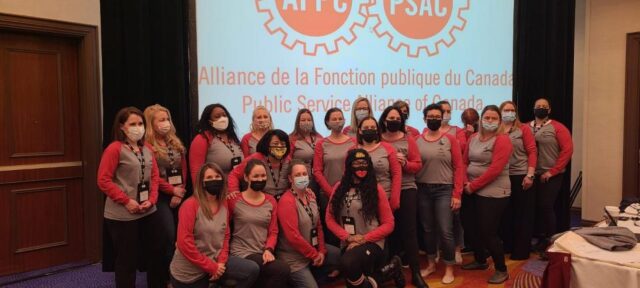
FB National Bargaining Conference brings together first ever women’s caucus

FB Conference Women's Caucus

A new round of negotiations for more than 8,500 PSAC-CIU members officially kicked off at the FB National Bargaining Conference — held in Ottawa March 31 to April 2 — where delegates from every CIU branch across Canada discussed the issues that will drive the next round of bargaining.

After issuing an input call for bargaining demands in December, PSAC received over 1,300 proposals from uniformed and non-uniformed members employed by the Canada Border Services Agency. Delegates reviewed and prioritized these submissions and discussed what to expect from the bargaining process.

Key bargaining issues raised at the conference included compensation improvements, pension reform, increases to leave provisions, discipline, early retirement benefits, hours of work, discrimination and harassment, job security, union rights, work-life balance, and health and safety.

Delegates also heard from members who were active in the last round of bargaining, as well as mobilization and organizing experts, to aid them in developing strategies to build on the success of last summer’s unprecedented mobilization actions, which ultimately helped secure a deal.

The conference broke new ground with women representing nearly half of all delegates at the conference and holding its first-ever women’s caucus. There were also many young workers in attendance. Overall, the conference brought together a diverse membership with experience in a multitude of roles, including border services officers, inland enforcement, hearings and intelligence.

It was also the first time the conference was held in a hybrid format that allowed delegates to participate in person in Ottawa and virtually from home.

The newly elected FB bargaining team consists of Michael William Fraser, Marjorie Gavel, Mathieu Landry, Jacqueline Monk, Lisa Morgan, Keith Palmer, Stewart Saunderson, and Jordan Smith. PSAC negotiator Morgan Gay and research officer Darren Pacione will also return to the team.

PSAC served Treasury Board with notice to bargain in February 2022. Following the conference, our newly elected bargaining team will meet at the end of April to finalize our bargaining proposals. We expect dates to be set for the first meeting with the employer in the coming months.

Stay in touch

Please be sure to keep your contact information up to date via the member portal to receive all the latest updates as we negotiate your next contract.

If you have any questions, please contact your CIU branch president or PSAC regional office.

This article was first posted on the PSAC website.

Common Issues: PSAC and Treasury Board still far apart after insulting wage offer

PSAC is keeping all options on the table to put pressure on Treasury Board after they came to the Common Issues table with an unacceptable wage proposal during negotiations March 28–31. The employer’s offer of 1.5%, 2%, 1.75% and 1.5% over a four-year agreement — averaging 1.75% per year from 2021–2025 — is completely out of touch with soaring inflation across Canada.

“This offer is a slap in the face to our members who have been delivering frontline services to Canadians throughout the pandemic,” said Chris Aylward, PSAC national president. “If the government expects our members to pay for the costs of the pandemic, they have another thing coming.”

The government is asking our members to take a pay cut when they need a raise most. Last year’s inflation rate topped out at 3.4% and this year’s rate is expected to be well above 4%. Indicators reached 30-year highs in February 2022 and inflation is not expected to drop below 2% for 2023 and beyond. PSAC has proposed wage increases of 4.5% per year to protect workers from the rising cost of living and ensure PSAC members and their families don’t fall behind.

Other than a response on wages, the employer’s offer did not address any of the union’s proposals. They only restated their position on their concessionary proposals related to technological change, discipline, numerous leave provisions, and the Work Force Adjustment Appendix (WFA).

“We’re prepared to meet with the government again to try and find common ground, but right now we’re simply too far apart,” added Aylward. “If Treasury Board fails to come to the table with an offer that keeps up with the skyrocketing cost of living, we will be forced to escalate our actions across the country, up to and including taking strike votes.”

Ramping up actions across Canada

We need your help to fight for a fair deal by turning up pressure on the government.

Register now for our April 12 national panel on fair wages to learn more about why mobilization is more important than ever and take action to demand fair wages. Then, join us on April 14 for our virtual day of action where we will flood the lines of Members of Parliament calling for fair wages and better working conditions.

You can also learn more about how inflation impacts your job with our conversation starter, “What does rising inflation mean for Canadian workers?,” support your bargaining team by wearing buttons or pins and send a powerful message to the employer by using our virtual bargaining materials.

Please be sure to keep your contact information up to date to receive all the latest updates as we negotiate your next contract.

This article was first posted on the PSAC website.

TC bargaining: Frustration mounts with Treasury Board

Treasury Board yet again failed to respond to PSAC’s proposals during the latest round of negotiations with the Technical Services bargaining team March 22-24.

Treasury Board’s stalling tactics are disrespectful, with representatives coming to the table empty-handed for months while also failing to respond to PSAC’s clear demands. This is unacceptable and an insult to TC members who continue to be on the frontlines of the pandemic serving Canadians.

If this were not enough, the few crumbs that Treasury Board has proposed amount to concessions under the guise of “flexible work arrangements.” Their proposals would allow managers to change people’s schedules on short notice or change day-workers into shift workers with little notice. The proposal would provide managers with more scheduling flexibility at your expense.

PSAC expects Treasury Board to put forward their wage proposal at the Common Issues table during negotiations March 29-31.

We put forward our wage offer of 4.5 per cent per year for all Treasury Board members at the Common Issues table last November.

See PSAC’s final wage proposal

The TC bargaining team is also proposing several other important gains for members, including protections for hours of work, improvements to overtime, and fixing the long-broken classification system through the Occupational Group Structure review.

The TC bargaining team will continue to push for fair wages, a better classification system, and reasonable working conditions for all TC members.

Take action and show your support

Your support is critical to our success at the table. As negotiations reach a pivotal moment, it is more important than ever to get involved and put pressure on the government to come to the table ready to negotiate fair wages and working conditions.

Join our April 12 national panel on fair wages with a strong lineup of speakers.

And register now for our April 14 day of action where PSAC members from across the country will be coming together to take action and flood the lines of MPs and cabinet ministers to urging them to come to the table ready to bargain.

Support your bargaining team with our digital backgrounds and talk to your coworkers about bargaining with the tools in our bargaining toolkit:

Please be sure to keep your contact information up to date to receive all the latest updates about bargaining.

This article was first posted on the PSAC website.

PA bargaining: Treasury Board stalls talks

Treasury Board continued to delay negotiations with the Program and Administrative Services bargaining team during negotiations March 22-24.

The PA team provided Treasury Board with a trimmed proposal package in February to try and move bargaining forward, but Treasury Board was unwilling to commit to any proposals.

PSAC expects Treasury Board to put forward their wage proposal at the Common Issues table during negotiations March 29-31.

We put forward our wage proposal of 4.5 per cent per year for all Treasury Board members at the Common Issues table last November. The PA pay proposal submitted in February builds on the Common Issues proposals, calling for additional adjustments and allowances for specific classifications within the PA group.

Common Issues

PSAC’s Common Issues bargaining team met with Treasury Board in February to discuss issues that impact members from every table, including work-life balance, wages, and new memorandums of understanding. Check out the full Common Issues update for more information.

Day of Action and stay in touch

Join our April 12 national panel on fair wages with a strong lineup of speakers.

And register now for our April 14 day of action where PSAC members from across the country will be coming together to take action and flood the lines of MPs and cabinet ministers, urging government to come to the table ready to bargain.

Stay informed and engaged during this round of negotiations using our bargaining toolkit.

Please be sure to keep your contact information up to date via the member portal to receive all the latest updates as we negotiate your next contract.

This article was first posted on the PSAC website.
PSAC celebrates 699 leave victory

In a major victory for federal public service workers hardest hit by the pandemic, an arbitration board ruled that Treasury Board cannot force employees to exhaust all their other leave before accessing 699 leave for COVID-19-related reasons.

This decision means that PSAC members who filed individual grievances related to 699 leave — where members were forced to use other available leave like sick leave, vacation leave or family leave before accessing 699 leave — can now request the leave be reimbursed to their leave banks.

Treasury Board’s heavy hand during the pandemic

The 699 leave provision is for “other leave with pay” and members can request it through their manager when they are unable to report to work for reasons beyond their control. This is different from sick leave and vacation time.

PSAC members relied on 699 leave to grapple with radical work-life changes during the pandemic. Parents were often left with no choice but to apply for 699 leave when schools and daycares were closed or went remote, but the government heavily restricted its use.

The restrictions disproportionately impact marginalized groups who have been the hardest hit by the pandemic, including women, Black, Indigenous and racialized employees, workers with disabilities, high-risk workers and workers with family obligations.

PSAC filed several policy grievances with Treasury Board, CFIA and other agencies for restricting the use of 699 leave. Two of these grievances were then brought before the Federal Public Sector Labour Relations and Employment Board.

The Board found the 699 leave policy breached PSAC’s collective agreement by requiring employees to exhaust other leave before 699 leave could be granted. The Board ruled this posed an undue burden on employees and violated members’ collective agreements.

On parental leave specifically, the Board ruled that denial of 699 leave to parents who “chose” not to send their children to school or daycare is not discriminatory or a violation of the collective agreement. Although parents may have a right to choose to keep their children at home” this was a choice and not a right that is protected by human rights legislation, the Board ruled. PSAC is reviewing this aspect of the decision for potential grounds for judicial review given the evidence that parents had little to no choice regarding childcare during the pandemic as well as the state of human rights jurisprudence on the issue of sex and family status discrimination.

Requesting 699 leave

If you need leave related to COVID-19, you should continue to request 699 leave. If your request is denied or you are forced to take other types of leave, reach out immediately to your PSAC regional office or your component labour relations officer to discuss whether you should file an individual or group grievance, including a grievance citing discrimination on the grounds of sex, family status or disability.

Stay up to date about 699 leave and other important issues by updating your contact information and signing up for our latest updates.

This article was first posted on the PSAC website.

PSAC files policy grievances against federal vaccination policy

PSAC logo SCFP
PSAC logo SCFP

PSAC continues to support vaccination as a critical public health measure to protect our workplaces and our communities. Yet as public health restrictions begin to lift across the country, it’s important to take a critical look at the federal government’s vaccination policy and how it is applied to PSAC members.

As the pandemic has evolved and the science has developed, we believe continuing to put unvaccinated employees on leave without pay is a harsh administrative measure that can be considered disciplinary and without just cause.

PSAC has filed policy grievances on behalf of all members in the federal public service – including Treasury Board, Canada Revenue Agency, the Canadian Food Inspection Agency and Parks Canada – who have been put on leave without pay because of their vaccination status.

As part of the remedy, we have requested compensation for members should they continue to be placed on leave without pay because of the government’s policy. PSAC’s grievances come as the government begins to review its vaccination policy six months after its implementation.

Throughout the pandemic, we have continued to support members who have had their human rights or workplace rights violated because of their vaccination status.

PSAC continues to consult with the federal government on its vaccination policy to ensure it reflects the latest public health guidelines while protecting the health and safety of our members and their rights in the workplace.

Policy grievance for remote workers remains active

Though all workers are included in this latest policy grievance, PSAC had previously submitted a different policy grievance covering only remote Treasury Board employees in December 2021, with a subsequent submission for remote CRA employees earlier this month.

PSAC argued at the time that the federal government’s mandatory vaccination policies to place remote workers on leave without pay constituted an abuse of management authority because remote workers, who had little to no prospect of returning to physical workplaces in the long term, posed no reasonable threat to the health and safety of their workplaces.

This article was first posted on the PSAC website.