
Anti-racism training for Customs and Immigration Union members: Letter to Minister Blair

Photo of CIU flag

CIU National President Jean-Pierre Fortin sent the following letter to the Hon. Bill Blair, Minister of Public Safety and Emergency Preparedness, on June 5, 2020.


Dear Minister,

This past week, people from around the world witnessed the death of George Floyd at the hands of police in Minneapolis. These events lay bare the systems and culture that result in unequal treatment and racism in the law enforcement and other institutions. Canada’s Prime Minister and many federal representatives have rightly pointed out that although this event took place in the United States, our country is not immune to racism, unconscious bias and systemic discrimination. Police Chiefs and associations have issued open letters calling for reform. The cries of Canadians are loud and clear, they will not tolerate injustice and the Customs and Immigration Union (CIU) adds its voice to theirs.

As you know, the CIU represents some 11,000 members, many of whom are Border Services Officers. While they enforce the law, their role is unique in that they are the first to come into contact with travellers to Canada from around the world.

Many of the CIU’s members are racialized and we know that they are hurting. We also know that racism is everywhere, within various groups and in all workplaces. Its impact is far reaching. Our union wants to take concrete steps in an effort to support our members and all those who are also suffering due to racism, discrimination and unconscious bias perpetrated in workplaces and beyond.

The Prime Minister has pointed out that far too often, our current systems condone and normalize inequality and injustice. He also stated that the Government of Canada is ready to work with Canadians to eradicate racism and has called on allies to help build a fair, better and more equitable country for all.

The CIU National Executive discussed ways in which our union might become such an ally and call on you to work with us to create genuine change. If Canadians are being called on to combat unconscious bias, we asked ourselves how we might participate in that fight. We believe that to achieve societal reform, we will need to replace current “reactive” methods and processes with “proactive” ones. No doubt the Federal government and perhaps you, as Minister of Public Safety, are contemplating various avenues to address this matter. Unions and employers must be active partners in the dismantling of systemic discrimination and the development of a more progressive model of law enforcement.

It is our understanding that many law enforcement organizations provide anti-racism training. The CIU wants to ensure its members have the tools necessary to combat discrimination of all kinds. In-person, comprehensive training will go a long way to preventing the suffering of our members and those they meet and serve, be it in an office, at the border, in an airport or elsewhere. Current and short “presentations” to new recruits do not go far enough and neither will online training ensure that we are equipping our members to address systemic racism and unconscious bias.

The Canadian government has taken a proactive approach to combatting racism, funding a variety of initiatives. In keeping with that approach, we strongly believe that in the long term, funding enhanced training initiatives will be to everyone’s benefit. It is clear that current “reactive” policies and procedures, such as the ones the world has been witnessing lately, are costly and ineffective. Investment in training for CIU members is an important first step to help them to become stronger allies and leaders in the fight against racism and discrimination of all kinds.

Yours truly,

Jean-Pierre Fortin
National President
Customs and Immigration Union

Click here for the PDF version.

Employers and unions must address systemic racism

Photo of CIU flag

This week, a PSAC member was terminated after sharing a racist video that mocked the murder of George Floyd.

We were appalled at the creation and distribution of such disturbing and offensive content. It is particularly troubling when we consider that one of the people involved, worked for a major federal institution.

It demonstrates just how pervasive and systemic the problem of racism is.  No institution is immune. Unions, small business, large companies, public employers – we all have a great deal of work to do in order to eradicate racism.

At this critical moment, we call on all PSAC employers to work with us to create the genuine change that can address systemic racism. We have a diverse membership across the country, and they all deserve to be part of a union and workplace that not only rejects racism, but actively works to dismantle the structures and behaviour that sustain it.

Individuals must always be held accountable for their actions; however this is not a problem to be pinned on a single person or a few “bad apples”. We are long past the point of thinking we can make things better by simply reacting to individual acts.

Unions and employers have the ability to address systemic racism together, and PSAC is committed to being an active partner in this important work.

The original version of this article was first posted on the PSAC website.

PSAC defends 699 leave for COVID-related child care needs

Image of border crossing with the words "COVID-19"
PSAC has filed a policy grievance after the Treasury Board of Canada Secretariat (TBS) changed the guidelines to restrict how public service workers can use “Other Leave With Pay” (699) to fulfill child care needs related to COVID-19.

Little progress one year after report on Missing and Murdered Indigenous Women and Girls

image of an Indigenous dancer wearing a red dress

More than a year has passed since the final report of the National Inquiry into Missing and Murdered Indigenous Women and Girls. Many are frustrated by the government’s inaction, even though Prime Minister Justin Trudeau said on the anniversary that ending this national tragedy is an urgent priority for his government.

“How can an urgent priority translate into a year of inaction?’ said PSAC National Executive Vice-President Magali Picard. “This is simply a continuation of the federal government’s indifference to the plight of Indigenous women and girls, and a contradiction of their supposed commitment to reconciliation.”

PSAC fully supports the statement issued by the commissioners of the public inquiry, and calls on the federal government to follow through on their commitments to Indigenous peoples and communities.

The original version of this article was first posted on the PSAC website.

Anti-Black racism: It’s everyone’s fight

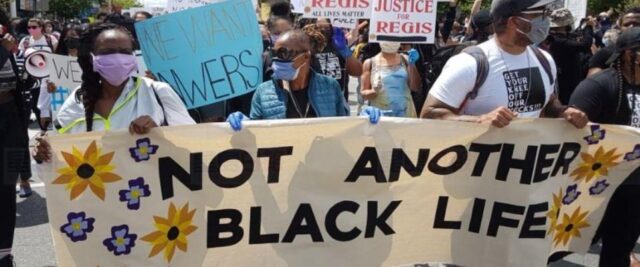
protest image with the words "not another black life"

Once again a spotlight has been put on systemic anti-Black racism in the justice system – one that has oppressed Black, racialized, and Indigenous people for centuries. Most recently, in the United States, Ahmaud Arbery a Black man who was simply jogging was shot to death, and George Floyd a Black man buying groceries, was killed by police officers. Breonna Taylor, a Black woman, was shot in her home in the middle of the night.

In other cases, white people threatened to call the police on Black people for simply participating in every day activities such as: bird-watching, working out in a gym, driving through a neighborhood, etc. These are activities white people do without fear every day and yet, for Black citizens, no activity can be accepted as “safe” when society is rife with systemic racism and those entrusted to protect all citizens repeatedly murder unarmed Black civilians.

Only after videos were released and protests erupted across the country were charges brought against police officers in two cases involving the killing of unarmed Black men. Not enough is being done. Anyone who uses unnecessary violence and force, whether resulting in death or harm must be held accountable – especially police officers and white supremacists. Rarely in the past have they been charged let alone convicted.

There are those who feel that this is an American issue. It is a Canadian issue too. Black people across Canada have been, and continue to be, racially profiled through carding and other forms of racially biased surveillance. A 2018 interim report from the Ontario Human Rights Commission found that Black people are grossly over-represented in police violence in Ontario. Although the Black population was about 8.8% in Ontario in 2016, use-of-force cases involving Black people was 30%. During the period 2013-2017, deadly police encounters with Black people were 60% and fatal shootings were 70%. Most recently, it was alleged that police were involved in the death of Regis Korchinski-Paquet, an Indigenous-Black woman who fell to her death from the 24th floor balcony of an apartment in Toronto.

Black people must be able to walk, jog, shop, play, work, sleep and engage in everyday activities without fearing for their lives. Black lives matter. Black parents should not have to talk and prepare their children about violence and hatred directed towards them as a result of the colour of their skin, including the possibility of being killed by those who were meant to protect them. Black lives matter.

PSAC stands in solidarity with the Black community and demands justice both in the United States and in Canada. The impact of systemic racism must be recognized.  The pain, and the impact of the repeated killing of Black and racialized people, and the continuous images of violence against Black and racialized people in the media and social media platforms must be recognized. Black Lives Matter.

PSAC demands that racial profiling and the unnecessary violence used against Black people be stopped immediately. Before justice can be served, a complete overhaul of the criminal justice system and other systems that support the oppression of Black, racialized and Indigenous People must be undertaken as a first step to eliminate the deep-rooted systemic racism and unconscious bias against Black, racialized and Indigenous people.

Silence as white or non-racialized people is complicity with white supremacy and with continuing acts of systemic anti-Black violence. What actions can we take collectively against anti-Black violence and oppression?  How can we best support the Black community?  We must challenge our systems and institutions.  We must speak up in the face of injustice, racial violence and white supremacy. We must challenge our unconscious biases. We must be part of the solution.

“If you stay neutral in situations of injustice, you have chosen the side of the oppressor”
– Desmond Tutu

“Injustice Anywhere is a Threat to Justice Everywhere”
– Martin Luther King Jr.

The original version of this article was first posted on the PSAC website.

This is what a successful return-to-workplace plan looks like

Man working at computer

PSAC is working hard to make sure the federal government takes every necessary precaution to ensure that the return to federal offices and workspaces across the country is safe for employees, their families, and the general public.

PSAC insists that the health, safety, wellness, and privacy rights of public service workers must be at the centre of the return to workplace plan and that it reflect the fact that, until a COVID-19 vaccine is created, the virus poses an ongoing threat to the physical and mental health of workers.

PSAC also takes the position that:

  • All return-to-workplace provisions must be in line with collective agreements and legal obligations.
  • Since specific equity groups have been disproportionately impacted by COVID-19, the plan must be created with a strong equity and human rights lens.
  • The overall plan and any specific measure must adhere to direction from public health authorities and assessments from professional experts in order to contain the spread of the coronavirus.

Additionally, PSAC is urging the following measures:

Conditions for returning to the workplace

  • Provide clear guidelines for determining who will be selected to return to workspaces and who will continue to work from home. Decisions should not be left to the discretion of management to avoid discrimination.
  • Provide employees who are returning to the workplace with a reasonable notice period of at least two weeks to allow them to manage the transition and to do so gradually.
  • Allow workers living with an immunocompromised individual to continue to work remotely to minimize exposure within their household until a vaccine becomes available.
  • Continue our members’ access to “Other Leave with Pay” (699) to accommodate various circumstances including, but not limited to, child care responsibilities that are related to COVID-19, including if parents are unable to or choose not to send their children back to school or daycare.
  • Acknowledge that productivity will be negatively affected by the pandemic and that employees’ performance evaluations should not consequently be negatively affected.
  • Allow for genuine consultation and negotiation with bargaining agents on any reorganization of work. Especially in the event that changes would trigger Work Force Adjustment obligations.

Public transit and shared spaces

  • Consider how returning to offices or workspaces increases a worker’s risk of exposure to the virus as it may require them to drop children off at school or childcare, ride a bus or train, use a public washroom or ride an elevator.
  • Include a strategy to ensure workers can remain at a 2-metre physical distance from others, including in shared spaces, but still have access to necessities such as washrooms, elevators, microwaves and fridges.
  • Address how an employer will proceed when 2-metre physical distancing is not possible in elevators, entrance ways, stairwells, washrooms, and routes to and from public transit.
  • Consider the impact on workers who cannot take public transit because of risk of exposure, and therefore support accommodations like additional or reduced-price parking available for those who can drive to the work site.
  • Ensure that employers implement health and safety strategies such as staggered scheduling, controlling or restricting access to common spaces, more frequent cleaning/disinfecting of the workplace, preparing and training for emergency situations, as well as training and communication on COVID-related health and safety procedures and the use of personal protective equipment (PPE).

General health & safety, sanitation and workers’ needs

  • Provide a robust sanitation plan and risk assessment of federal government workspaces.
  • Include a plan to track cases of COVID-19 in the public service, including procedures that must be followed after a worker tests positive.
  • Address Personal Protective Equipment (PPE) needs and align these needs with the recommendations of provincial and territorial health agencies who have called for the use of masks and gloves, especially when physical distancing is not possible.
  • Outline support for teleworkers in terms of ergonomic support, mental health, and appropriate working equipment.
  • Provide managers and Occupational Health & Safety Committees with additional situation-specific training to deal with the range of mental health problems that are likely to result, or have already, due to COVID-19.
  • Provide sufficient medical research and an assessment by a technical professional to determine how ventilation systems can contribute to virus transmission.
  • Include a plan to ensure all sanitation and ventilation systems are in ongoing compliance with the Canada Occupational Health and Safety Regulations (COHSR).
  • Consider slowing the pace of the conversion to Activity-Based Working. All work arrangements should be considered and evaluated in the context of COVID-19.

Child care

  • Provide clear guidelines on how to accommodate employees who may have to continue to provide childcare while also working due to COVID-19.
  • Allow parents to use “Other Leave with Pay” (699) to fulfill childcare needs related to COVID-19, including if some parents may be forced to keep their children home despite some schools and childcare facilities re-opening.
  • Include plans to negotiate with PSAC at the bargaining table so that its childcare proposal can be implemented as part of collective agreements.

Domestic and family violence

  • Provide an outline for the steps that will be taken to ensure employees are supported and feel protected from violence at home; whether they return to the workplace or continue to work from home.
  • Include a plan to finalize an agreement with PSAC on domestic violence leave.

Employment equity and human rights

  • Include a management approach that recognizes the disproportionate impact of COVID-19 on specific groups, such as people with disabilities, women, racialized and Indigenous people.
  • Incorporate guidelines that will ensure that human rights, privacy rights and employment equity obligations are being met by the employer.
  • Include plans to consult with the NJC Joint Employment Equity Committee and departmental employment equity committees on changes to any practices, processes and policies that can potentially effect workers (telework, technological changes, workspaces, etc.) due to the disproportionate impact of COVID-19 on equity groups.

Privacy

  • Stipulate that any disaggregated information (age, gender, race etc.) collected that may be relevant for collective bargaining will be provided to PSAC so that we can determine any disproportionate impact of COVID-19 on our members.
  • Ensure that any health or employment data collected by an employer observes privacy obligations and is stored in a secure manner.

PSAC is demanding that the government continue meaningful consultation with federal unions throughout the development and implementation of a return-to-workplace plan.

Until an acceptable overall plan is developed, PSAC strongly recommends that our members continue to work from home where possible.

We will provide further updates on the development of a plan as more information becomes available.

The original version of this article was first posted on the PSAC website.

COVID-19: Postponement of 2020 National Convention & Branch Elections

Photo of CIU flag

Last week, the CIU National Board of Directors (NBoD) met virtually to address the impact of the ongoing COVID-19 pandemic on our upcoming National Convention. Taking into account current public health considerations, the CIU NBoD voted to postpone the October 2020 National Convention to 2021.

As our union’s supreme governing body, the National Convention plays a crucial role every three years in ensuring our organization is a vibrant and democratic one. The NBoD agreed to postpone the Convention so it could take place in a safe environment while upholding the participatory principles that are important to our members. While the current term is being extended to 2021, the usual schedule will resume thereafter and subsequent conventions will be held in 2023 and 2026.

The postponement of the National Convention also impacts our Branch Elections, which were scheduled for this fall. Barring any unforeseen circumstances, Branch Elections will now take place in 2021.

Information posted on the CIU national website will be amended to reflect the revised dates. As the current situation remains uncertain, dates could still change should there be new developments. We will make sure to keep you informed as things progress.

Grievance Regarding FB-02 Officers on 6990 Leave With Pay

Photo of CIU flag

As a result of the COVID-19 pandemic, the employer has instituted two types of leave to minimize the exposure of our members to each other and to the public.

Members who can still attend at the workplace have been placed on “Employee Health Days for Social Distancing” (091) so that they can stay at home but be available to attend work if required. FB-02 Officers are being provided with online training and scenario-based learning opportunities so that all of their days spent on 091 will count for the purpose of the Officer Induction Development Program.

Members who are unable to attend at work  for  reasons  directly  related  to  COVID-19  have  been placed  on  Leave  With  Pay  (6990).   FB-02  Officers  on  6990  are  not   being   offered   the opportunity to pursue online training. Further, for those who stay on this type of leave for more than 30 consecutive days, this time will not count for the purpose of the Officer Induction Program. This will effectively delay the assessment period for these FB-02 Officers for weeks or even months.

CIU has approached management to request that FB-02 Officers on 6990 not be penalized for being unable to attend at the workplace for reasons entirely out of their control. We take the position that these Officers are being subject to a discriminatory practice that will needlessly delay their promotion to FB-03. The employer, however, continues to be unwilling to allow time spent on 6990 to count towards the FB-02 assessment period.

If you are an FB-02 and have been on 6990 leave for a period of more than 30 consecutive days and wish to contest the employer’s refusal to recognize this time towards your assessment period, you may file the following grievance:

Grievance

I grieve that I have been the subject of a discriminatory practice on the part of my employer. I have been unable to attend at the workplace because of COVID-19 related issues and have been placed on 6990 Leave With Pay. The employer is refusing to count my time on 6990 leave in the calculation of service for the purpose of the Officer Induction Development Program. This creates an inequity as other FB-02 Officers who have been placed on 091 Social Distancing Leave are being credited with all days served.

Remedy

I ask that the employer credit me for all days spent on 6990 Leave With Pay for the purpose of completing my assessment period under the Officer Induction Development Program.

I ask that I be placed in the same position with respect to time served under the Officer Induction Development Program as all FB-02 Officers on 091 Leave.

I ask that I be afforded any and all other remedies as necessary to correct this inequity.

Get back to the table now

Image conversation PSAC AFPC

PSAC members stepped up to deliver the government’s massive response to COVID-19 in record time.

Yet the government continues to delay talks for a new contract for nearly 140,000 federal public service workers.

Tell the government to get back to the table. Now.

Go to the PSAC website to send a message to the Trudeau government telling them it’s time to reach a fair deal for public service workers.

FB bargaining: CBSA members on the front lines of COVID-19 deserve better

Photo of CBSA officer with orange epaulettes

PSAC/CIU Border Services members continue to play a pivotal role in Canada’s response to COVID-19, repatriating Canadians returning home from abroad and screening travellers at the border.

Despite their ongoing efforts, CBSA management still refuses to make meaningful progress towards a new collective agreement for more than 9,000 border services officers, investigators and headquarters staff.

During bargaining via teleconference May 12-14, our PSAC/CIU bargaining team made it clear that it is time the government addresses core workplace issues we’ve raised in negotiations concerning excessive discipline in CBSA workplaces, and crucial scheduling issues. The same is true with respect to parity with the broader law enforcement community, including much-needed pension reform.

Telework

We also raised our telework proposals with the employer. Given the reality that so many of our members are now teleworking during this crisis, it only stands to reason that our collective agreement finally addresses this issue for our non-uniformed members.

Technological change

Our team spoke to our proposals concerning technological change. We are looking for language in our collective agreement that would ensure meaningful consultation with PSAC-CIU on any changes, and that no bargaining unit jobs be lost due to technological change. The COVID-19 crisis has again shown that machines cannot do the job of trained CBSA officers.

Workplace protections

CBSA rejected our proposals for protections against surveillance in CBSA workplaces and when officers are asked to remove their tools. We explained that we are maintaining our position on these issues. New protections are needed against CBSA management in our collective agreement.

PSAC prepared to take legal action against CBSA

Recently, CBSA announced its plan to unilaterally change scheduling practices in Toronto, despite opposition from the union and our members. As a result, PSAC put Treasury Board/CBSA on notice this week that it will take legal action if such changes are implemented.

Our team also indicated that PSAC legal counsel will take action should CBSA proceed with changes to the escort and removal procedures that undermine our work and our rights under the collective agreement. We will uphold our rights.

Parity with law enforcement community

Our review of recent law enforcement wage settlements across Canada is ongoing – including our monitoring of wage talks for a first collective agreement for RCMP officers. Wage trends for 1st Class Constables at the RCMP are critical for comparative analysis to our group. Once the analysis is complete, we will commence wage discussions with the employer.

We also raised with management this week the issue of employees being provided T2200 forms for claiming home office expenses with the Canada Revenue Agency. The employer indicated that it is working on the issue.

We are in the process of setting additional dates with the employer.

To review the package of proposals that we tabled as well as those of the employer, visit psacunion.ca/fb-group. We’ll continue to provide updates throughout the bargaining process. To see other updates on Treasury Board bargaining, check out psacunion.ca/treasury-board.

The original version of this article was first posted on the PSAC website.