Canadian Police and Peace Officers’ 41st Annual Memorial Service

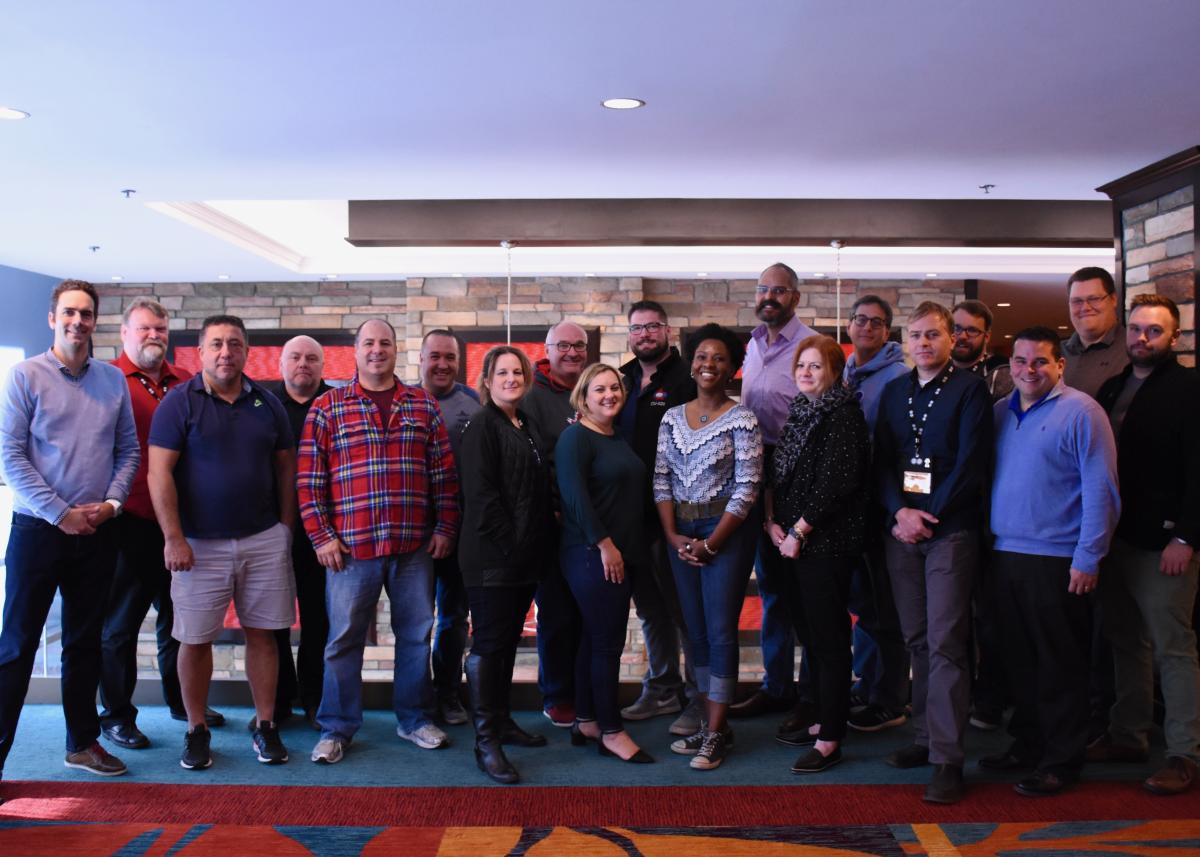
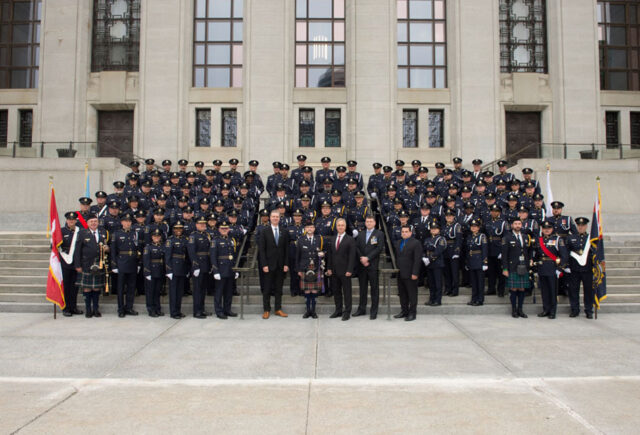
Border Services Officers attending the 2018 Police and Peace Officers' Memorial Service

On September 30, 2018, CIU members and representatives from across the country attended the Canadian Police and Peace Officers’ 41st Annual Memorial Service. Paying homage to those who have paid the ultimate price for keeping Canada safe is certainly one of the most significant gestures anyone can make.

CIU is grateful to all who were present to honour their law enforcement brothers and sisters. Your dedication to this Memorial and your professionalism in representing your coworkers are truly appreciated.

Border Services Officers attending the 2018 Police and Peace Officers' Memorial Service

Border Services Bargaining to Begin in January

Bargaining

With bargaining input gathered from every CIU branch across Canada and our FB Bargaining Team now elected and in place, PSAC has proposed dates in January to the Treasury Board to commence negotiations for a new FB collective agreement. An update will be provided once dates are confirmed. We look forward to getting back to the bargaining table and making CBSA a better place to work.

November 21, 2018 update: Last Friday, PSAC and Treasury Board confirmed that the parties will exchange proposals and commence negotiations for a new collective agreement for the Border Services (FB) group the week of January 7th, 2019.

Stay up to date with bargaining news by visiting the PSAC’s Border Services bargaining webpage, or sign up to receive the PSAC’s e-News.

A version of this article was first posted on the PSAC website.

Reduction of Hours of Operation at Ports of Entry: Customs and Immigration Union Expresses Concerns

CIU Flag / Drapeau du SDI

Press Release – Ottawa, November 12, 2018 – The National President of the Customs and Immigration Union which represents 10,000 members, most of whom are front line border services and inland immigration enforcement officers, has raised concerns regarding the recent announcement that effective November 26, 2018, the Canada Border Services Agency (CBSA) will be reducing the hours of operation at nine ports of entry in New Brunswick, Quebec, Manitoba and British-Columbia.

CIU National President Jean-Pierre Fortin provided details of the looming closures, outlining the larger issue of CBSA’s continuing reduction of operational capabilities:

“Hours of operation will be reduced in the future at the Fosterville, Milltown, Morses Line, South Junction, Tolstoi, Piney, Snowflake, Carson and Nelway ports of entry. In August 2017, CIU had expressed concerns regarding a similar reduction in hours of operation in New Brunswick and had predicted that CBSA would expand this practice to other ports of entry. This month’s reduction in hours is clearly a continuation of what began last year. The only explanation provided by CBSA is that this is being done to harmonize Canada’s hours of operation with those at US facilities. No consideration is being given to the bordering communities who will be impacted by the reduced hours of service, or to the overall safety of Canadians.”

On the latter point, Fortin highlighted the clear contradiction between reducing hours of operation at ports of entry and the Government of Canada’s stated aim of wanting to increase security at the border.

“In a recent press release, the Government of Canada announced additional funding for CBSA to invest in new resources and technology that will stop the flow of illegal firearms into Canada. While we welcome the additional funding, we know that technology cannot replace seasoned officers. It is baffling to us that on the one hand CBSA would put in place new technology to stop the flow of illegal goods, while on the other reduce the hours of operation at nine ports of entry. The recent weapons seizure in Fort Erie should serve to remind us all – the country’s first line of defence must not only be well-equipped, it must be properly staffed.”

Fortin further calls upon the Canadian Government and CBSA to use the increased funding to invest in additional border officers and expand their role to ensure the integrity of the Canadian border. He added that if there was no other alternative to reducing hours of operation, border officers should at the very least have the authority to travel between ports of entry and monitor the ports after hours.

“While Americans benefit from a dedicated border patrol that can maintain their country’s security even when a port of entry is closed, Canadians do not.

Current events show that the border never sleeps. A dedicated CBSA border patrol would go a long way towards maintaining our border’s integrity. Whether we’re talking about asylum seekers crossing outside of designated ports of entry or the trafficking of dangerous goods such as firearms and drugs, border officers need to be able to react quickly and efficiently. A dedicated border patrol would see border officers better equipped to perform their duties to protect, and hence ensure the safety, security and well-being of Canadians.”

The Customs and Immigration Union (CIU) is a component of the Public Service Alliance of Canada (PSAC), which represents Canada’s Front-Line Customs and Immigration Officers. CIU also represents Investigation, Intelligence and Trade Customs Officers, Immigration Inland Enforcement and Hearings Officers, as well as all support staff – all of whom work at the Canada Border Services Agency (CBSA).

Update: Accommodations for Use of Force Limitations

Arming Initiative Featured Image, depicting the hand of a BSO on a holstered firearm
On October 24, 2018, the CIU National Executive, Brother Star and Sister Amy Kishek, PSAC Legal Officer, met with the CBSA for a G-1 consultation meeting. The Employer advised that following Phase I, it has regularized 78 accommodations which are now permanent placements. These Employees have already received their letters of offer.

Victory: PSAC Secures Over a Million Dollars Owed to Border Services Members

CIU Flag / Drapeau du SDI

PSAC-CIU has successfully challenged, through a policy grievance, a Canada Border Services Agency (CBSA) breach of the Border Services (FB) collective agreement that expired June 20, 2014.

PSAC had negotiated a new annual allowance for all employees performing Border Services duties. The amount was set at $1,250 annually for non-uniformed officers and $1,750 annually for uniformed officers, to be paid monthly to all BSOs who worked a minimum of 75 hours in that calendar month. The Employer however refused to compensate members who worked the 75 hours in the month of June 2013.

Following PSAC-CIU’s legal challenge, the Federal Public Sector Labour Relations and Employment Board (FPSLREB) recently issued a decision affirming that the Employer needed to pay all members in accordance with the provisions of this new allowance for the month of June 2013. This decision makes it consistent with the sick leave and annual leave provisions. This victory will see over 1 million dollars given back to the Border Services members affected and sets a precedent for any future allowances negotiated with similar language.

A version of this article was posted on the PSAC website.

PA, EB, TC & SV Groups Bargaining: PSAC Proposes 3.75% Wage Increase Per Year and Additional Improvements

Bargaining

Bargaining teams representing nearly 90,000 federal public service workers were at the bargaining table with Treasury Board (TB) on October 16-17. This week’s sessions involved elected teams from the Program & Administrative Services (PA), Technical Services (TC), Operations Services (SV), and Education & Library Science (EB) groups, whose collective agreements expired this summer.

PSAC’s bargaining teams remained disappointed by the continued lack of response and meaningful engagement by TB negotiators at the table. Similar to PSAC’s experience at the common issues bargaining session on October 10-11, government representatives did not engage substantially with PSAC’s various proposals, and also did not bother to offer counter proposals.

The teams all proposed economic increases of 3.75% per year for the 2018-2020 period. In addition, each team presented wage adjustments and allowances, as well as other proposals at their specific tables.

Specific bargaining proposals at-a-glance

Program & Administrative Services (PA)

Proposals from the PA bargaining team include a Public Safety Allowance for workers at security agencies in constant risk of mental or physical injury, a Primary Responsibility Allowance for Parole Officers, a higher retention bonus for workers having compensation and benefits related duties, and improved working conditions and training for call centre workers.

The PA team also reiterated its proposals to: improve compensation for overtime work, better address family responsibilities, and enhance work-life balance.

Technical Services (TC)

The TC bargaining team tabled a comprehensive wage proposal that seeks to expand and roll all current allowances into salary, add two increments to the top of all members’ pay scales, as well as introduce new occupational allowances to help address a substantial pay gap with others who do similar jobs.

Moreover, the TC team reiterated previously tabled proposals around fair job classification, leave improvements, hours of work, and travel time.

Education & Library Science (EB)

The bargaining team focused its wage proposals on closing the pay gap between EB members and those working outside government in comparable sectors, such as public school boards and academic libraries. And it followed up on a previously tabled proposal to negotiate a new national rate of pay for 12-month Elementary and Secondary Testing (ED-EST) teachers, which government negotiators have been sitting on for more than four months.

The team also presented new proposals aimed at increasing opportunities for professional development.

Operational Services (SV)

The SV bargaining team proposed market adjustments (in addition to the economic increases mentioned above) for a wide range of job classifications to eliminate the pay gap between public sector positions and comparable jobs in the private sector, as well as initiatives associated with salary grid restructuring. The team also tabled language proposing improvements to the terms and conditions contained in some of the group-specific appendices.

The team also further discussed measures to protect pay and benefits in situations necessitating a Duty to Accommodate.

Next bargaining dates

The next bargaining sessions will be held on:

  • November 27-29 for table specific proposals
  • ​December 4-6 for common issues proposals

PSAC has demanded that government negotiators come to the next set of bargaining meetings ready to respond to our proposals and begin meaningful negotiations.

A version of this article was posted on the PSAC website.

PSAC Victory Secures Compensation for Victims of Workplace Sexual Assault

CIU Flag / Drapeau du SDI

PSAC secured an important victory this past week when the Federal Court of Appeal ruled that a member should be compensated for the sexual harassment and assault she experienced in her workplace.

The case involved a border services officer who had been continually sexually harassed by a co-worker since May 2008, which culminated in a sexual assault on August 2009. While the employer and the Board did not dispute that sexual harassment and assault did occur, the Board nevertheless decided that compensation for pain and suffering was not warranted despite clear evidence of significant emotional trauma

In its decision, the Board referred to the sexual assault as a “vulgar prank” and considered the reaction of the target of the assault as “extreme” and “grossly exaggerated.” The Board further maintained that because the victim was a “confident” employee she ought to have taken different steps in having the matter reported and resolved.

Thanks to the courage of the member who brought this case forward, PSAC successfully appealed the Board’s decision and received the positive ruling last week. The Federal Court of Appeal confirmed that there is an obligation to compensate victims of sexual harassment and violence, and further, that sexual assault survivors can be compensated for harm suffered regardless of whether the sexual assault was the sole cause of the harm.

“This is such an important victory for any victims of sexual harassment and assault in the workplace. The message is clear: the impact on workers should be taken seriously, and they should be compensated for their suffering,” said PSAC National President Chris Aylward.

The Court was also very critical of the Board’s original decision for having perpetuated rape myths. The Court affirmed that there is no one typical response by victims to sexual assault, and further that the Board could not substitute its own concept of common sense in place of the actual evidence of pain and suffering.

A version of this article was posted on the PSAC website.
Common Bargaining Issues: PSAC Frustrated by Lack of Progress on Treasury Board Bargaining

Bargaining

The bargaining team representing the common issues for nearly 80,000 public service workers resumed contract negotiations with Treasury Board (TB) on October 10-11, but left the meetings disappointed and frustrated. TB negotiators have yet to table proposals on a number of issues they previously flagged for discussion, and came to the table with no response to most of PSAC’s proposals, which they have had since June.

Despite the Government’s inaction, PSAC’s bargaining team continued advancing our members’ interests and concerns on a number of key issues. They presented proposals on pay administration and Phoenix-related issues, mental health in the workplace, childcare, and a protocol for negotiating the terms and conditions of work for civilian members of the RCMP who are pay-matched to PSAC bargaining units.

Our Phoenix-related demands include:

  • Employees are to be paid on time, and daily interest is to be paid to employees who do not receive their proper pay, based on the Bank of Canada’s daily compounded interest rate.

  • No repayments of overpayments are to be made until all the employee’s pay issues have been resolved. Moreover, the repayment schedule will not exceed 10% of the employee’s net pay unless the employee opts for a larger amount.

  • Rules around salary and benefit advances, and language providing for accountant and financial management counselling for employees negatively impacted by Phoenix.

PSAC’s bargaining team put Treasury Board on notice that for the next common issues bargaining session scheduled for the first week of December, we expect government negotiators to table the remainder of their proposals, and to finally start negotiating seriously.

This week’s bargaining session included elected teams representing members from the Program & Administrative Services (PA), Technical Services (TC), Operations Services (SV) , and Education & Library Science (EB) groups, whose collective agreements expired this summer.

Bargaining sessions for each specific group will be held on October 16-17.

A version of this article was posted on the PSAC website.
Border Services Delegates United and Ready for Upcoming Negotiations

FB Bargaining Conference / Conférence nationale, négos du groupe FB

PSAC / CIU members working at the Canada Border Services Agency (CBSA) held a Bargaining Conference in the National Capital Region, October 10 to 12, 2018, to prepare for upcoming negotiations for a new collective agreement. Border Services delegates from across the country are united and ready to fight for a fair collective agreement.

Delegates reviewed membership recommendations for contract improvements, discussed the bargaining process and developed mobilizing strategies for members in their regions and across Canada.

Delegates also elected the Border Services (FB) Bargaining Team, which will sit across from the employer throughout negotiations and fight for improvements to the current contract. The most recent four-year collective agreement with CBSA expired June 20, 2018.

The team will provide regular updates during the bargaining process. The full package of bargaining proposals will also be made available once it is presented to the employer.

We strongly encourage members to visit the FB bargaining webpage, sign up to receive the PSAC electronic newsletter directly, and stay in touch with elected bargaining team members:

Border Services (FB) Bargaining Team

  • Leanne Hugues, Border Services Officer, British Columbia
  • Claude Bouchard, Border Services Officer, Quebec
  • Frances Baroutoglou, Border Services Officer, Ontario
  • Jonathan Ross, Border Services Officer, Atlantic
  • Michael Aessie, Border Services Officer, Prairies
  • Mathew Ashworth, Border Services Officer, Ontario
  • Ken Turner, Border Services Officer, Ontario
  • Joey Dunphy, Border Services Officer, Atlantic
  • Charles Khoury, Senior Program Officer, National Capital Region

FB Bargaining Team

Alternates

  • Mathieu Landry, Quebec
  • Murray Star, Ontario
  • Stewart Saunderson, Ontario
  • Tammy Firlotte, Atlantic
  • Jordan Smith, Ontario
  • Keith Palmer, British Columbia
  • Andrew Wiersema, Ontario
  • Emily Henry, Ontario

PSAC Research Officer

  • David-Alexandre Leblanc

PSAC Communications Officer

  • Jonathan Choquette

PSAC Negotiator

  • Morgan Gay

A version of this article was posted on the PSAC website.

Border Services Bargaining Conference Begins Today

CIU Flag / Drapeau du SDI

Border Services (FB) delegates are meeting this week in the National Capital Region for a three-day bargaining conference. Members from across the country are gathering from October 10 to 12 in order to prepare for upcoming negotiations for a new collective agreement.

Throughout the conference, the delegates are:

  • learning about the collective bargaining process,
  • reviewing bargaining proposals and discuss priorities,
  • developing mobilization strategies, and
  • electing their bargaining team members.

Treasury Board signed their most recent agreement on July 3, 2018.

The four-year collective agreement, which expired June 20, 2018, finally delivered the respect deserved as law enforcement personnel, including the largest increases for law enforcement personnel achieved by any union in Canada for the same period of time.

Stay up to date with bargaining news by visiting the Border Services bargaining webpage, or sign up to receive the PSAC electronic newsletter.

A version of this article was posted on the PSAC website.