

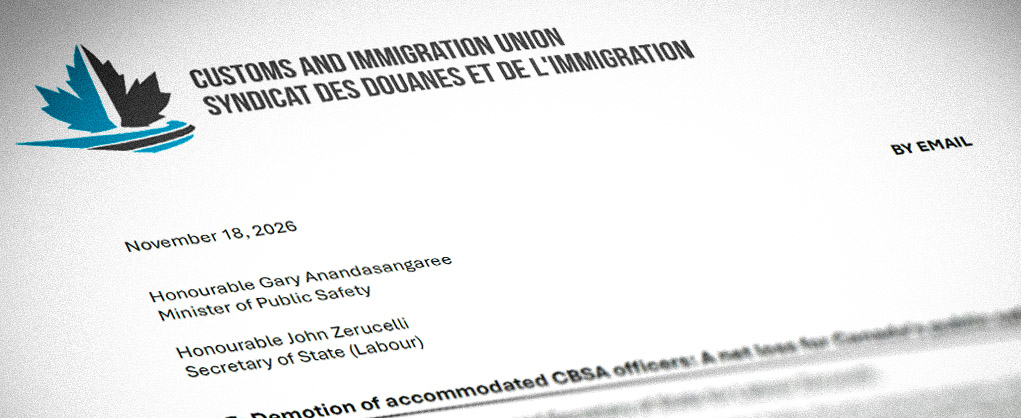
CIU National President Mark Weber sent the following letter to the Minister of Public Safety and the Secretary of State for Labour on November 18, 2026.
Dear Minister Anandasangaree and Secretary of State for Labour Zerucelli,
Canada Border Services Agency (CBSA) officers need your help. As you may be aware, in the summer of 2025, CBSA undertook a review of accommodation agreements for border officers with restrictions around arming and/or use of force. While the Agency refers to this as its “Reasonable accommodation process” (RAP), it has become evident that this process is neither reasonable nor does it aim at accommodating employees. Indeed, it would seem that the purpose of this review is effectively to terminate existing agreements by demoting experienced officers — a course of action that is discriminatory, arbitrary, and unfair.
Originally, the review involved 190 officers who were accommodated due to restrictions (medical or other) around arming and use of force, such as carrying a duty firearm. While some of these employees have since indicated that they would a) accept relocation in at-level positions or b) go through the required recertification process to continue in their current position, or c) retire, upward of 60 employees are still having their accommodation agreements reviewed and are now facing demotion.
In late October 2026, these remaining employees were notified by the employer that there were no at-level or equivalent positions left and that all employees remaining in the process would be considered for placement into lower-level positions, effectively being demoted without salary protection. Employees who decline an offer of placement in a lower-level positions face being placed on leave.
Let’s be clear, the message the Agency is choosing to send could not be simpler: All CBSA officers are disposable and are just one injury away from being discarded.
From the beginning, the Customs and Immigration Union expressed concerns with the Agency’s plan to review accommodation agreements en masse. As you know, CBSA, as an employer, has a legal obligation under the Canadian Human Rights Act and the FB (Border Services) collective agreement to protect people with disabilities from discrimination. While it is within an employer’s right to review accommodation agreements, this must be done on a case-by-case basis and there must be a genuine attempt at exhausting all accommodation options before considering demoting employees. The ‘blanket’ approach the Agency is pursuing is contrary to established accommodation principles.
What’s more, demonstrating a deep lack of understanding of the work border officers perform, the Agency has adopted the position that being armed is an intrinsic condition of employment, using this as a justification to move accommodated officers out of their current positions, despite the fact that these employees have been fulfilling BSO duties in their accommodated positions for years.
Border law enforcement is complex and goes far beyond carrying a firearm, the primary purpose of which is as a protective tool. Officers with restrictions regarding arming bring the same level of expertise and can make the same legal determinations as tooled officers. The true value of an officer’s work rests in that very expertise, not in the firearm, and the list of duties accommodated officers can perform without a firearm/use of force is vast: Nexus Enrollment, Hearings Assistant, Intelligence Analyst, Nexus Risk Assessments, Targeting, Commercial releases, low-risk refugee claims examinations, facilitative immigration work, etc.
Accommodated officers can also help your government achieve its public safety goals. In the 2026 Budget, your government has made supporting the integrity of the immigration system and reducing the backlog of cases across immigration enforcement processes clear priorities. This includes screening, admissibility work, and investigations, all duties that accommodated officers can perform without being armed, on work premises and remotely. The House of Commons Standing Committee on Public Safety and National Security also highlighted the importance of retaining accommodated officers to “preserve operational expertise and stabilize frontline staffing levels” in its recent report on the management of the border. To do away with these officers would represent a net loss for Canada’s public safety.
Ultimately, there is no evidence that the Agency has attempted to treat each employee on a case-by-case basis, that it has sought to genuinely understand the reasons why individual employees cannot be armed, or that it has engaged in meaningful dialogue with affected employees to tailor sensible solutions. CBSA will say they have exhausted all options; that is false. There is no reason why these officers cannot be accommodated in their current position. By refusing to do so and by threatening demotion, the Agency is failing to recognize the value of these employees’ skills as Border Officers, effectively taking advantage of them. Demotion is not recognition.
Minister, Secretary of State, I am sure you will agree that this is not how Canada’s second largest law enforcement agency should treat dedicated officers after years of dutiful service. Will you act to prevent more than 60 officers from being unfairly demoted?
I remain at your disposal to discuss this important matter in person, and I look forward to your response.
Yours truly,
Mark Weber
National President
Click here for the PDF version of this letter.