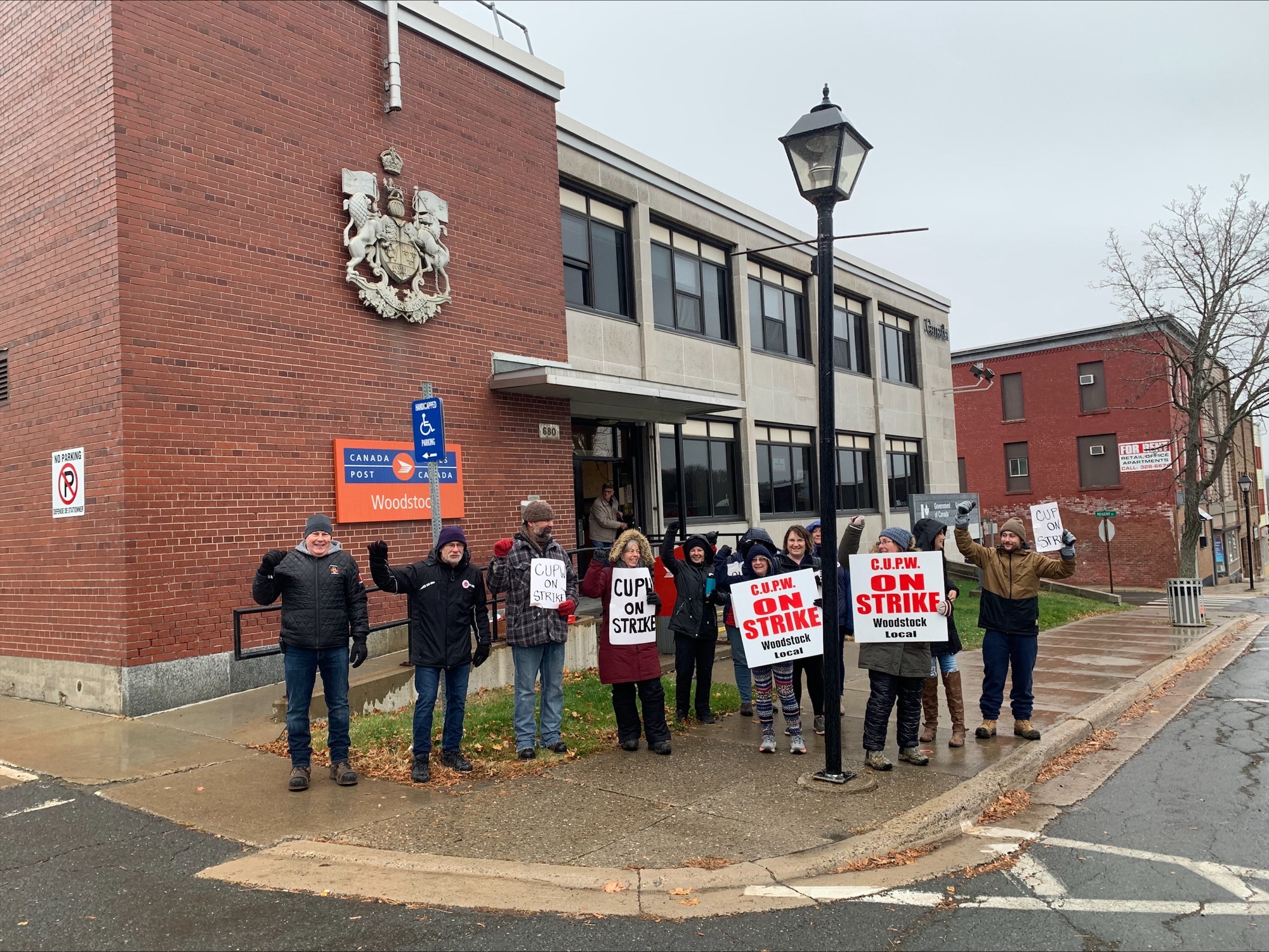
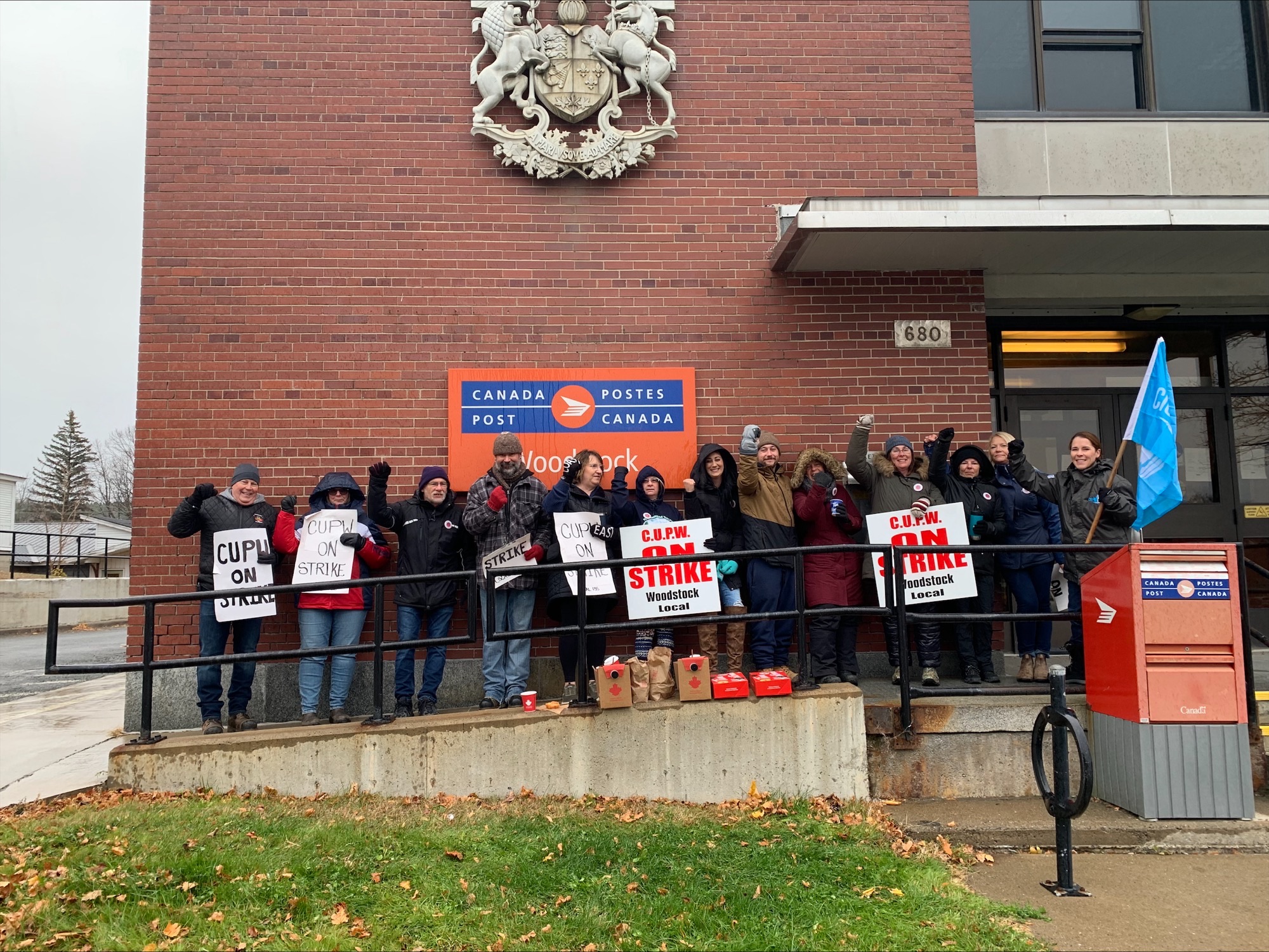
In New Brunswick, CIU NB-PEI Branch President Marjorie Gavel stopped by the picket line in Woodstock earlier today to show solidarity with striking workers (and drop off muffins, donuts and coffee!). Despite the cold and the damp, spirits were high.
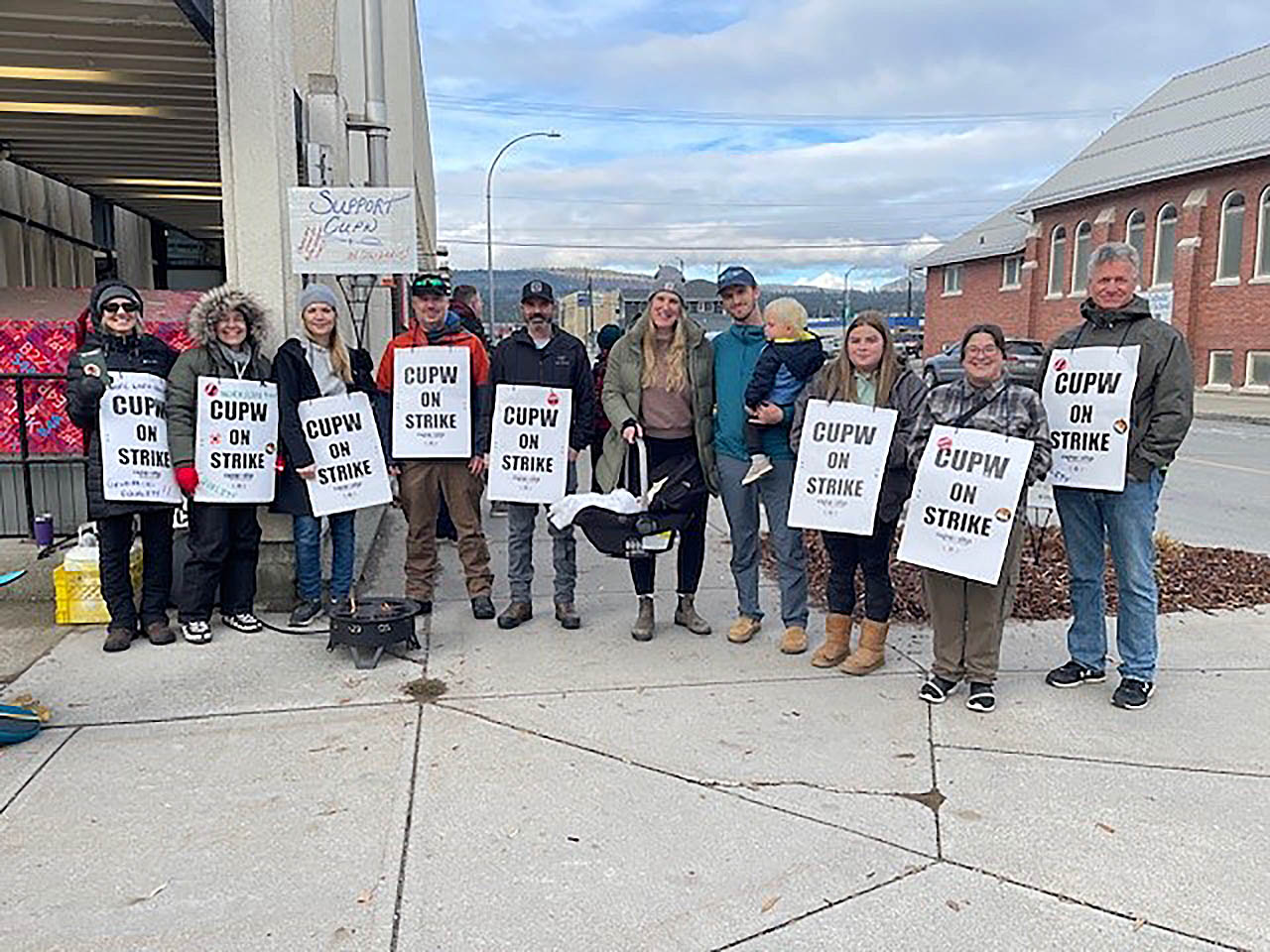
In British Columbia, CIU Young Worker Representative Kevin Kerr, along with his family, dropped by the CUPW local 728 picket line in Cranbrook to show support.
Support CUPW
While CIU members are not in a legal strike position, you can support CUPW members by joining picket lines during unpaid breaks and before/after your work day (FB members, please remember not to attend while wearing your uniform and tools). Let’s show solidarity with postal workers!
Canada Post workers from the Canadian Union of Postal Workers (CUPW) need your solidarity.
Fair wages, improved health and safety, sound pensions, and increased staffing are on the bargaining table. But their employer hasn’t offered real solutions.
On Tuesday, CUPW served a 72-hour strike notice to Canada Post. Canada Post workers at CUPW will be in a position to strike this Friday, November 15, 2024.
As a PSAC member, you are not in a legal strike position, and you must continue to report for duty. Here’s what to do in the event of a CUPW strike:
Continue showing up to work. You will still have access to your workplace even if you’re in areas where CUPW has established picket lines.
During your lunch breaks, and before or after your work day, join the picket lines to express solidarity with CUPW members.
If you feel it is unsafe to cross the picket line, contact your supervisor and union representative.
Make note of the entry points at your workplace for PSAC members. A CUPW picket captain will specify.
When PSAC members were on strike against Treasury Board, our CUPW colleagues joined us on the line. Now it’s our turn to show solidarity.
PSAC has serious concerns about the federal government’s plans to reduce government spending by cutting public service jobs.
Without prior consultation, the government unilaterally announced their plans to cut costs across the federal public service during a briefing with unions on the Refocusing Government Spending Initiative November 7.
The 2023 budget outlined $15 billion in cuts to programs and services over the next four years, with another $3 billion in spending reductions announced in last year’s Fall Economic Statement.
When cuts were first announced in 2022, Mona Fortier, Treasury Board President at the time, said the government would find $6 billion in savings by increasing remote work and selling off real estate.
Last year, Treasury Board President Anita Anand promised workers wouldn’t be asked to do more with less and that there would be no job losses. Then we heard that 5,000 jobs would be reduced through natural attrition.
Today, we heard a very different story. The government is now widening the net, looking to cut term and casual employees, and opening the door for departments to slash permanent employees through Workforce Adjustment.
Federal departments have been assigned specific budget reduction targets in salary line items. PSAC is insisting that unions must be consulted while these targets are reviewed. These targets, protected under Cabinet privilege, will remain confidential until they are made public in June 2025.
Workers and Canadians are waiting in limbo. Families who benefit from critical programs won’t know if the services they depend on will be cut. Public service workers won’t know if they’ll have jobs by next summer – if they can renew their mortgage, start a family or pay their student loans.
Government savings should not fall on the backs of workers and the services they deliver to Canadians.
The government should instead go after the billions they’re wasting on contracting out public services and the massive savings remote work offers for Canada’s public service.
PSAC will be fighting back against these cuts and protecting workers caught in the crossfire.
This article was first posted on the PSAC website.
On November 11, we remember and honour the thousands of women and men who have laid down their lives for our country.
Remembrance Day presents us with an opportunity not only to recognize the dedication and sacrifices — past and present — of Canadians of all horizons, but also to reflect on how to build a better, fairer world where such sacrifices may no longer be necessary. To the women and men who have demonstrated courage and commitment in the face of adversity, we thank you.
In honour of all who have served, CIU will be half-masting the National Flag of Canada flying at the CIU National Office, in Ottawa.
The Customs and Immigration Union is aware of the tragic incident that took place earlier today (November 9) in Windsor, where a border officer took their life at work. We wish to express our most sincere condolences to the family, friends and colleagues of the deceased — our thoughts are with all who are affected by these difficult circumstances.
Incidents such as this one bring to light the challenges public safety personnel may be confronted with throughout their career, and they remind us of the need for a comprehensive mental health support structure and of the importance of taking down barriers to access these services, both in professional and private settings. These tragedies also serve as a reminder of the value of supporting each other in the face of hardship. The death of a member is difficult for all, and we recognize the impact this sad event has on our community — should any member require support, please contact the Employee Assistance Program (EAP) at 1.877.367.0809 (TTY: 1.877.338.0275) for confidential assistance.
Out of respect for the deceased and their family, CIU will not be commenting further at this time.
Workplace mental health directly impacts employee well-being, productivity, and overall organizational success and is a crucial factor in creating a supportive, sustainable, and productive work environment.
The Public Service Alliance of Canada (PSAC) and the Treasury Board of Canada Secretariat (TBS) are pleased to release the Joint Study on Mental Health Support Mechanisms for Employees, which is focused on improving mental health support for federal employees. The study explores how exposure to workplace trauma—whether directly or indirectly—can impact mental well-being and offers solutions to address these challenges.
Background
The study follows an agreement reached in October 2020 during collective bargaining with the Program and Administrative Services and Technical Services groups. Its goal was to identify roles that expose workers to explicit, disturbing material or potentially dangerous situations and determine how best to support these workers.
The study aims to:
Enhance understanding of how to support workers at risk of psychological harm.
Minimize the risks of trauma exposure in the workplace.
Identify the specific mental health support workers need.
Highlight best practices and recommend ways to implement them across departments.
Collaboration and process
The Joint Committee on Mental Health Support Mechanisms, made up of union and employer representatives, co-chaired by members of both parties, conducted the study. Their collaborative work shows how unions and employers can join forces to improve workplace mental health.
In the course of their work the committee
Gathered evidence to develop criteria to identify high-risk roles across departments.
Assessed current mental health programs and identified gaps.
Reviewed existing literature on trauma-related mental health support.
Findings and recommendations
The study found that, although mental health resources are available, it’s unclear how frequently they are used or how effective they are. It also highlighted the need for better systems to identify psychological risks in the workplace.
The report emphasizes the need to:
Equip workers and managers with mental health knowledge to identify risks.
Strengthen informal peer support networks.
Provide recovery options for affected employees.
It also recommends that employees and managers participate in joint training. This approach helps build stronger peer networks and improves engagement, with managers playing a key role in program success.
Looking ahead
The study offers a framework for departments to improve their mental health action plans, which ultimately will benefit the entire federal workforce.
Union and management representatives on Occupational Health and Safety Committees are encouraged to use the study as a guide and take steps to apply its recommendations.
As part of our collective agreements for federal workers, PSAC negotiated a letter of agreement (LOA) on telework to protect workers from arbitrary decisions about remote work. The LOA was designed to ensure that managers assess each remote work request individually, rather than as a group. It also required managers to provide written responses, helping PSAC hold the employer accountable for fair and equitable decision-making.
However, the federal government violated this agreement by unilaterally imposing a rigid one-size-fits-none mandate, forcing workers back to the office three days a week.
PSAC is actively fighting back against this backwards mandate through legal challenges and a joint campaign with other public service unions to defend your rights. Because if the government can so easily break this agreement, what’s stopping them from undermining the rights of other groups? Our collective strength is the key to protecting all workers from the erosion of hard-fought gains.
Progress on joint review panels
Despite these obstacles, PSAC has been working closely with components and federal government departments to establish joint union-management review panels. These panels provide a fair, case-by-case review process for resolving grievances related to remote work.
If your telework request relates to a request for accommodation, it will not be reviewed by the joint panel, as accommodation requests should follow the appropriate duty-to-accommodate procedures.
So far, panels have been set up for over 100,000 members, including in major departments and agencies such as Employment and Social Development Canada, National Defence, and the Canada Revenue Agency. Work is ongoing to establish panels across all remaining departments to ensure every member has access to this resolution process.
How the process works
The joint review panels are an alternative dispute resolution mechanism for members whose telework requests have been denied. They offer recourse for grievances that have not been resolved at earlier stages, giving members an opportunity to have their cases reviewed by a joint panel of union and employer representatives.
Here’s how it works:
Start with your telework request: Submit your new or revised telework request and await the written decision from your manager.
File a grievance: If your telework request has been denied, we encourage you to file a grievance and follow the established grievance process under the collective agreement.The point of filing grievances is to hold the employer accountable. When we’re bargaining for the next round, these grievances will provide concrete examples of the way our members have been impacted.Remember, you should seek support from your union when submitting a grievance. Contact your local and/or component for support from a steward or labour relations officer before proceeding.
Access the joint panel: If no settlement is reached prior to the final step of the grievance procedure, you have the option to refer the grievance to the joint review panel. The process varies by department, so you’ll need to contact your component for support as they will understand the terms of reference and process that applies to you.The joint review panel will review the submissions presented by the parties and make a non-binding recommendation to the Deputy Head or their delegate who holds the final level decision in the grievance procedure.
Next steps
PSAC will continue to keep you updated on the status of the joint panels and next steps in our fight to protect your right to fair and flexible work arrangements.
CIU members, including National President Mark Weber, joined federal NDP leader Jagmeet Singh on October 17, as the NPD announced a commitment to rehire 1,100 border officers in an effort to stop the flow of illegal firearms into the country.
“The men and women of the CIU can stop guns from entering this country. But because of Conservative cuts, ports of entry are chronically understaffed,” said Singh at the press conference in Toronto on Thursday. “The NDP will fight for 1,100 new border officers to be urgently hired and trained to replace the jobs Conservatives cut. If the Liberals continue to let people down, an NDP government will rehire those 1,100 border officers immediately and keep hiring and keep training.”
Thanking Singh for his commitment to properly staff the border and support frontline border personnel, the CIU National President was clear: The reality at CBSA is bleak. “Many of our members face exhaustion due to sustained understaffing” explained Weber. “Things desperately need to change at CBSA if we want to get serious about stopping illegal firearms: more frontline border personnel, expanded abilities for our border officers to patrol between ports of entry, improved training facilities, reliable tools that don’t break down, and even benefits in line with other law enforcement agencies to help with the workforce renewal.”
Mark Weber highlighted the positive commitment from the federal government to introduce pension reform for frontline personnel this fall, including border officers, which should help the Agency retain dedicated personnel and have a beneficial impact on the long-term. “That’s a first step” said Weber, “and there’s so much more work that needs to be done”, emphasizing the need for the Agency to stop relying on automated technology that only serves to make our border less secure, and hire officers to find the dangerous goods that threaten our communities.
“CBSA officers get in this line of work because they want to keep Canadians safe, and they deserve to be given every tool they need to be successful,” concluded Weber. “What we’re hearing today from the NDP is exactly the kind of support that we need.”
This is the second time the CIU National President addresses a parliamentary committee regarding the bill. Mark Weber previously appeared as a witness in front of the House of Commons Standing Committee on Public Safety and National Security in June 2023 on the same subject. Thanks to CIU’s testimony and to recommendations from that Committee, the final version of the bill adopted by the House of Commons featured notable improvements, including around union involvement.
Reporting problematic behaviour from managers
Still, as the CIU National President pointed out to the Senate Standing Committee tasked with reviewing the bill, important questions remain. “The Agency is well-known amongst its employees for letting gross abuse by management run unchecked, and it is difficult for CBSA employees to see complaints about managers go addressed through existing channels” explained Mark Weber, highlighting that “CBSA managers often promote the very atmosphere that allows bad behaviour to flourish.” To help address this, it is important for Bill C-20 to include clear language around an employee’s right to report problematic conduct from managers, ensuring that CIU members can avail themselves of the recourses offered by the PCRC.
Concerns around time limits
The National President also brought forth pressing concerns around time limits, as complaints to the PCRC could be made up to two years after an incident allegedly occurred. “Some [of our members] are dealing with hundreds of travellers a day. Imagine a complaint coming in about a five-second interaction that happened 18 months ago. The odds of having an ability to recollect or know what happened are close to zero. That is not fair for the accuser or the accused,” said Weber to the Committee.
Further expanding on the issue around time limits, Mark Weber also added that “you need specific timelines in terms of when an investigation comes to a resolution. For every step, timelines need to be included. Right now, it looks like these investigations could go on for years with no real, clear deadlines as to when a decision has to be made.”
CIU submitted a brief to the Committee detailing the union’s concerns and recommendations. Read it here.
Pension legislation also needs to be updated
During his opening statement, the CIU National President also restated the need to overhaul legislation around early pension eligibility for CBSA personnel before C-20 is enacted, so that the benefits our members have access to are consistent with the additional oversight proposed by C-20. “CBSA law enforcement personnel are at a disadvantage compared to their peers working for other similar agencies,” explained Mark Weber. “They must work longer before retirement, often becoming sick or injured on the job, or unable to meet the physical demands of their work.”
The inconsistency between C-20 and existing pension eligibility is something that the National President had flagged to the House of Commons Public Safety Committee in June 2023. CIU was encouraged in June of 2024 when the government announced that legislation enabling such changes would be tabled this fall.
“We’re looking forward to these changes in the very near future” said Weber on Monday, emphasizing “how important it is that these occur before C-20 is enacted.”
See selected clips below. A full recording of the Committee proceedings can be viewed here(with interpretation language options).
Trade unions reaffirm their stance: without peace, there can be no social justice, and without social justice, peace cannot last.
Military confrontations in almost every region of the world are worsening, leading to widespread loss of life, livelihoods and rights. Working people are on the frontline of this growing crisis, facing daily injustices and oppression.
Since 2021, Myanmar’s military dictatorship has violently repressed workers and their families, stripping them of basic rights. The people of Myanmar are demanding democracy, starting with the recognition of the National Unity Government.
Since 2022, Russia’s illegal invasion of Ukraine has caused unimaginable human suffering and cost thousands of lives. The global trade union movement continues to call for peace and the restoration of Ukraine’s sovereignty.
In Palestine and Israel, the worsening conflict has killed and displaced thousands. Trade unions demand an immediate ceasefire, the release of the hostages and all those detained without due legal process, the safe return of all workers trapped by the conflict, increased humanitarian aid and a lasting two-state solution.
Luc Triangle, General Secretary of the ITUC, said: “Governments are failing to resolve conflicts through diplomacy, while workers and their unions continue to engage in peaceful negotiations. Workers must be involved in the peace and reconstruction processes if they are to succeed and create the necessary conditions for lasting peace and stability.
“We need a complete change of priorities away from strategic competition, violence and confrontation to common security, negotiation and peace. Rising military expenditure is diverting critical resources away from social priorities. Over US$91 billion was spent on nuclear weapons alone in 2023; ten billion more than in 2022. World military expenditure totals US$2.5 trillion.
“Imagine the benefits to people everywhere if this money was invested in decent work, education, healthcare, and the transition to a green economy? With this money we could deliver the New Social Contract. We need to start investing in peace, not war. Disarmament is a question of justice and is key to building a peaceful world with shared prosperity.”
This World Day for Decent Work, workers demand peace and democracy.
This article was first posted on the PSAC website.