
September 20 protests against 2SLGBTQIA+ inclusive school policies

This Wednesday, September 20, far-right, conservative and anti-trans groups are organizing protests against teaching 2SLGBTQIA+ content in schools. These protests are being organized under the hashtag #1MillionMarch4Children.

The protests also support recent legislation passed in Saskatchewan and New Brunswick which demand that teachers advise parents if their children request to be called by a different name or pronoun. While these groups claim to be in support of ‘parental rights’, the protests are actually anti-2SLGBTQIA+ hate rallies which aim to eliminate Sexual Orientation and Gender Identity (SOGI) curriculum and policies from Canadian schools

Politicians across Canada and the Conservative party in particular, continue to threaten the human rights of 2SLGBTQIA+ people by failing to support 2SLGBTQIA+ positive legislation. Sadly, these politicians are actively enabling these anti-2SLGBTQIA+ protests to occur in 80 locations across Canada, with large events planned in major cities. PSAC strongly condemns any and all bigotry and violence that threatens the fundamental human rights of 2SLGBTQIA+ people

September 20 will be a challenging and scary day for 2SLGBTQIA+ peoples and their communities. PSAC joins in solidarity with you.

PSAC urges all members and allies to:

These groups will not stop at targeting 2SLGBTQIA+ people. Recent incidents of violence and harassment across Canada make the real impact of this kind of hate starkly clear. Trans bodies and lives are on the line, and it’s up to all of us to take a stand.

An injury to one truly is an injury to all.

This article was first posted on the PSAC website.
PSAC challenges caps on damages in Canadian Human Rights Act

PSAC logo SCFP
PSAC logo SCFP

PSAC has filed a challenge with the Federal Court of Canada, calling for the removal of caps on human rights damages in the Canadian Human Rights Act, on the basis that these caps violate constitutional equality rights.  

When a federal worker who has experienced discrimination in the workplace is awarded financial compensation for damages under the Canadian Human Rights Act there is a limit on the amount of damages they can receive. Since 1998, this limit has been capped at $20,000 for pain and suffering; and an additional $20,000 may be awarded where it is found that the employer discriminated in a wilful or reckless manner.

While there are limits on damages for discrimination, the amount of compensation a court can order for any other wrongful act on the part of the employer is not subject to the same limits. When a worker experiences discrimination based on sexism, racism, disability, or other human rights grounds, the impacts on their work, their life, and their health can be monumental. A global cap of $40,000 cannot meaningfully compensate a worker for pain and suffering and willful discrimination engaged in by an employer. This is especially the case given that these caps have not been adjusted for inflation since they were introduced 25 years ago.

Limiting damages under the CHRA is an added act of discrimination against individuals who have already experienced harm from discriminatory treatment on the part of their employer.

PSAC has filed a challenge to the limits on damages, on the basis that these limits violate equality rights guaranteed under the Canadian Charter of Rights and Freedoms. PSAC has filed its Statement of Claim* and evidentiary record, including expert affidavits. The government has filed its Statement of Defence** and is expected to file its evidentiary record in due course.  A hearing date has not yet been confirmed.

For more information 

Read PSAC’s statement of claim
*Unfortunately, the statement of claim is only available in English at this time. 

Read the government statement of defence 
**Unfortunately, the statement of defence is only available in English at this time. 

This article was first posted on the PSAC website.

Show your support at a Labour Day event near you

Each year on Labour Day, we recognize the contributions of workers and reflect on the rights we have fought for over the years, including fair wages, safer working conditions, and the right to organize collectively.

This year, we’re celebrating Labour Day on the heels of one of the largest strikes in Canadian history. Thanks to over 100,000 PSAC members who came together on picket lines to demand better, we secured the strongest collective agreement in the federal public service that raises the bar for our members and all workers in Canada.

In Nunavut, PSAC members at the Iqaluit Housing Authority picketed for 136 days to secure wages that lift workers who are struggling with one of the highest costs of living in the country.

These victories — and many more by PSAC members this year — are a reminder that when workers unite, we can build lasting change.

Labour Day celebrations and marches are being organized across the country. Show your support at an event near you.

This article was first posted on the PSAC website.

Public Service Health Care Plan: Canada Life transition update

PSAC logo SCFP
PSAC logo SCFP

Earlier this year, PSAC announced that we successfully negotiated key improvements to the Public Service Health Care Plan (PSHCP) for federal public service workers, and the new plan came into effect on July 1, 2023.

On the same date, the employer transferred the PSHCP provider contract from Sun Life to Canada Life as part of a separate procurement process, resulting in changes for nearly 1.5 million federal public service workers, retirees, and their dependents. This change was initiated and operationalized by the employer and was not part of PSAC and other unions’ negotiations on a new health care plan.

This transition has caused frustrating challenges for plan members and their dependents. Unfortunately, Canada Life has not been able to keep up with the influx of new members, retirees, and dependents that they now administer, and it is having a significant impact on people who depend on these benefits for their health and drug coverage.

Before the move to Canada Life, PSAC provided the government with recommendations for a smooth transition for plan members, including for Canada Life to hire additional staff and increase its call centre capacity.

Nearly two months later, tens of thousands of federal workers are still experiencing issues with their new health care coverage. Many have been unable to register or log into their accounts and face long claim processing delays. These problems are compounded by members’ inability to reach a Canada Life customer service agent to help them.

Since July, Canada Life has made some improvements, including expanding their call centre hours to seven days a week and hiring additional staff to assist plan members.

As of August 25, Canada Life has reported that 99% of plan members have been successfully enrolled under the new benefits plan. But customer service wait times remain too long, and too many calls remain unanswered. This poorly managed transition prevents our members from fully taking advantage of their benefits.

The Government of Canada made the decision to transition to Canada Life and it is their responsibility to hold Canada Life accountable for the many problems that members are facing.

PSAC has requested a meeting with Treasury Board President Anita Anand to discuss how the delivery of benefits can be improved for plan members as soon as possible.

This article was first posted on the PSAC website.
Alternative Federal Budget sets roadmap for stronger public services

Read the 2024 Alternative Federal Budget

This year’s AFB focuses on investing in our public health care system, affordable community housing, anti-poverty and food insecurity initiatives, a green transition to combat climate change, stronger labour legislation, and a tax system that ensures the wealthy pay their fair share.

To achieve these goals, AFB 2024 recognizes the federal public service must be well-equipped to meet these ongoing challenges and deliver the services Canadians depend on. These recommendations include:

  • Adequate funding to rectify pay problems caused by the Phoenix pay system to ensure workers are paid accurately and on time every time;
  • A full review of staffing levels based on the needs of Canadians;
  • The creation of an independent consultation body to reduce the government’s reliance on private consultants;
  • A comprehensive review and amendment of the Federal Public Sector Labour Relations Act that improves the way unions like PSAC negotiate new contracts with the government;
  • Full funding for settlements of class action lawsuits, including the Black Class Action and the Indigenous Class Action, and more efforts to address oppression and discrimination;
  • Stronger whistleblowing legislation to protect workers;
  • Transparency and consultation in the use of AI and other automated decision-making tools;
  • An ongoing commitment to build a more inclusive federal public service.

The public service recommendations of AFB 2024 are reflective of the recommendations that PSAC made to the Finance Committee of the House of Commons (FINA), in preparation for their pre-budget consultation process.

“Public service workers are on the frontlines of program delivery to people in Canada. Our members see every day what works, and what can be improved,” said PSAC National President Chris Aylward. “We’ve made suggestions to FINA, and through them to the Minister of Finance, for a 2024 budget that will build robust programs and services that will put the needs of people first, creating the resiliency to see Canada through these difficult economic, social, and environmental times.”

By addressing these issues, Canada’s public service can remain a robust and flexible institution capable of serving Canadians effectively now and into the future.

Read the 2024 Alternative Federal Budget

This article was first posted on the PSAC website.

CBSA: Twenty years of undermining the human element

Photo of CIU flag

Recently, CBSA shared a post on social media celebrating its twentieth anniversary. What should have been an innocuous statement instead shed light on just how disconnected the Agency is from its history, its personnel, and its mission towards Canadians.

It’s hard to believe such a short publication could so succinctly embody much of what is wrong with the Agency’s vision for Canada’s borders.

From the ill-advised attempt at using an archive photo from what looks to be the 1930s to represent the turn of the millennium to the post’s sole focus on travel facilitation through automation, it’s clear the Agency understands little about the passage of time, and even less about what CBSA stands for.

While it’s easy to laugh at the idea that a federal agency seems to think that the early 2000s are indistinguishable from the first half of the past century, CBSA’s obsession with automation and facilitation is undoubtedly more concerning.

It will likely not come as a surprise to most border personnel who are used to the Agency’s ways, but it is telling that CBSA chose to highlight twenty years of existence by touting its automated kiosks without touching upon any aspect of border security whatsoever. It’s also telling that the Agency chose to illustrate the current state of affairs by using a sterile picture of its eGates with nary a person — traveller or Border Services personnel alike — in the foreground. Clearly, for CBSA, the human element is of little importance.

So, too, it would appear, is the security aspect of its mission. Our Border Services Agency plays a role far greater than simply facilitating entry at airports. As Canada’s first line of defense, CBSA officers are dedicated to protecting our communities. For the past twenty years, they have played a crucial role in keeping all manner of public safety threats that could harm Canadians out of our country — including dangerous offenders involved in trafficking illegal firearms, drugs, and child pornography. How little must the Agency think of this work to leave it out of a simple celebratory post? How little must it think of its personnel or its responsibility to Canadians?

Again — and sadly — this probably won’t come as a surprise to those working for the Agency. For years, CIU has called upon the government and CBSA to better support its officers and invest in its personnel, and for years the Agency has disregarded this, preferring to pursue the very opposite. Still, CBSA’s position has rarely been made as evident as it is in this latest social media post: The Agency is telling us loud and clear what it is, and it’s not good for Canadians. We should listen.

Eligibility for strike pay on May 1

PSAC logo SCFP
PSAC logo SCFP

PA, EB, TC and SV members who returned to work following the end of the Treasury Board strike on May 1 may be eligible for additional PSAC strike pay.

If you received the notice of return to work too late to be able to work your usual shift the morning of May 1, or the delay caused you to incur a financial loss based upon working a shorter day on May 1, you could be entitled to full or partial PSAC strike pay equivalent for the times in question.

Members who lost less than four (4) hours of wages but a minimum of one (1) hour of wages will be entitled to the equivalent of part-time PSAC strike pay (ranging from $53 dollars to $98.70 depending upon your work location based upon strike pay regulations) while members who lost more than four (4) hours wages will be entitled to the equivalent of a full day of PSAC strike pay (ranging from $75 to $141 depending upon your work location based upon strike pay regulations).

In order to be eligible, you must provide proof of loss of income or leave that you were required to use, then complete this form so that your PSAC regional office can process your request for additional PSAC strike pay.

This top-up will only cover the equivalent of PSAC strike pay. Please contact your component for further information regarding component strike pay top-ups where applicable.


Please note: CIU will issue strike top-up payments to members based on the information provided by PSAC. There is no need for members to contact CIU directly, as the required information will be communicated by PSAC to the component. Please make sure to complete the form so that your request can be processed by PSAC.


This article is based on content first posted on the PSAC website.

Quick reference guides for union representatives

What do I do? is a series of quick reference guides prepared by the Customs and Immigration Union to provide useful information to both new and seasoned union representatives on a variety of issues of interest to the membership. The series covers topics such as fact-findings and PSI investigations, the grievance process, mental health crises, use of force, tool removal, etc. While the reference guides are intended for union representatives, members will certainly find these informative as well.

Click on the image below to download the collected reference guides in a single PDF document, or see the links further down for each individual guide (PDF files).

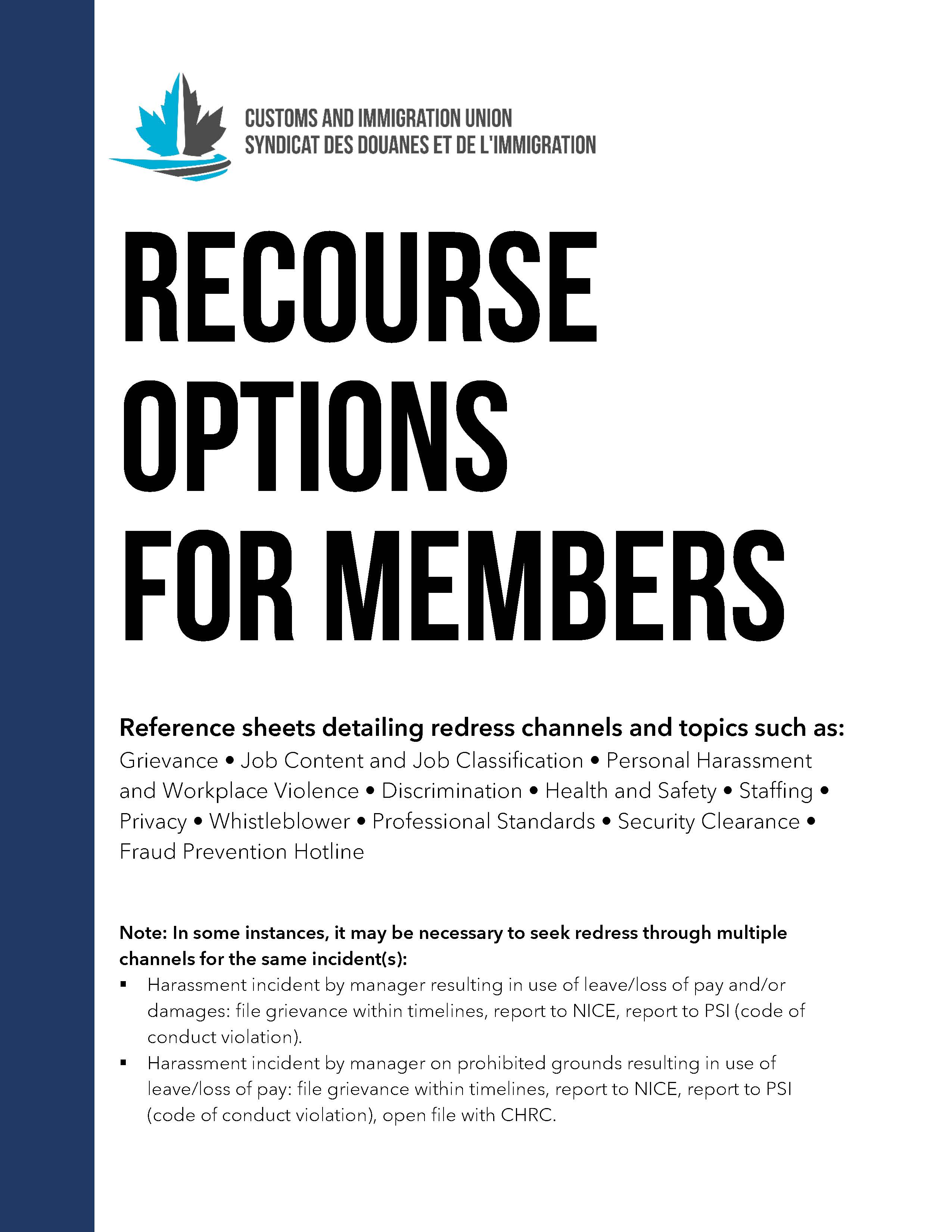
Related content: Recourse options for members

Recourse options for members

The Customs and Immigration Union has prepared easy reference sheets detailing different redress channels to help members navigate recourse options available in various situations.

Note that in some instances, it may be necessary to seek redress through multiple channels for the same incident(s). As always, please reach out to your local union representative(s) should you have questions regarding specific redress channels.

Click on the image below to download the collected reference sheets in a single PDF document, or see the links further down for each individual topic (PDF files).

Related content: Quick reference guides for union representatives